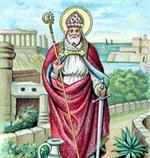
Pope Leo XIII on the Authority of the State
By Thomas V. Mirus ( bio - articles - email ) | Oct 29, 2026 | In Magisterium of Leo XIII
In multiple encyclicals already discussed in this series, Pope Leo XIII condemned the liberal view that civil rulers have no authority in themselves as granted by God, but only have it delegated to them by the consent of the governed. But his most thorough discussion of the nature and origin of civil authority was in his seventh encyclical, Diuturnum, published in 1881.
As usual, Leo begins by placing the issue in the contemporary context of social upheaval. The war against the divine authority of the Church has led, he says, to a war against the authority of the civil power. Thus the open hatred and ridicule of rulers, and political assassinations such as that of the Russian Emperor, Alexander II.
The reason for this logical progression is that Christianity lends stability and order to the state, the result being “a just and wise proportion of mutual rights and duties in both princes and peoples.”
The basis of civil authority had been chipped away for a few centuries by Leo’s time:
In every association and community of men, necessity itself compels that some should hold pre-eminence, lest society, deprived of a prince or head by which it is ruled, should come to dissolution and be prevented from attaining the end for which it was created and instituted. But, if it was not possible that political power should be removed from the midst of states, it is certain that men have used every art to take away its influence and to lessen its majesty, as was especially the case in the sixteenth century, when a fatal novelty of opinions infatuated many. Since that epoch, not only has the multitude striven after a liberty greater than is just, but it has seen fit to fashion the origin and construction of the civil society of men in accordance with its own will.
In particular, Leo refers to the social contract theory: that “all power comes from the people; so that those who exercise it in the State do so not as their own, but as delegated to them by the people, and that, by this rule, it can be revoked by the will of the very people by whom it was delegated.” (This is what Yves Simon referred to as the taxi-cab theory of authority—the government as a taxi driver whom you hire to take you where you want to go, but you can tell him to change directions or get out of the cab whenever you want.)
Leo argues from Scripture and natural reason that God is the source of all political power.
First, in the Old Testament:
Proverbs 8:15-16: Wisdom says “By me kings reign . . . by me princes rule, and the mighty decree justice.”
Wisdom 6:3-4: “Give ear, you that rule the people . . . for power is given you of the Lord and strength by the Most High.”
Ecclesiasticus 7:14: “Over every nation he hath set a ruler.”
Then in the New Testament, we have Jesus’ words to Pilate, and the teaching of St. Paul on the divine sanction of the governing authorities:
Let every soul be subject to higher powers, for there is no power but from God, and those that are, are ordained of God. Therefore he that resists the power resists the ordinance of God, and they that resist purchase to themselves damnation . . . wherefore be subject of necessity, not only for wrath, but also for conscience’s sake. (Romans 13:1-2, 5)
Leo also cites a few Church Fathers who taught the divine origin of civil power: Sts. Augustine, John Chrysostom, and Gregory the Great.
Then Leo makes a twofold argument from reason:
Nature, or rather God who is the Author of nature, wills that man should live in a civil society… But now, a society can neither exist nor be conceived in which there is no one to govern the wills of individuals, in such a way as to make, as it were, one will out of many, and to impel them rightly and orderly to the common good; therefore, God has willed that in a civil society there should be some to rule the multitude. And this also is a powerful argument, that those by whose authority the State is administered must be able so to compel the citizens to obedience that it is clearly a sin in the latter not to obey. But no man has in himself or of himself the power of constraining the free will of others by fetters of authority of this kind. This power resides solely in God, the Creator and Legislator of all things; and it is necessary that those who exercise it should do it as having received it from God.
Like civil rulers, priests also have their authority from God—fathers of families too are recognized as having “a certain impressed image and form of the authority which is in God.”
Leo further attacks the social contract theory:
Those who believe civil society to have risen from the free consent of men, looking for the origin of its authority from the same source, say that each individual has given up something of his right, and that voluntarily every person has put himself into the power of the one man in whose person the whole of those rights has been centered. But it is a great error not to see, what is manifest, that men, as they are not a nomad race, have been created, without their own free will, for a natural community of life. It is plain, moreover, that the pact which they allege is openly a falsehood and a fiction, and that it has no authority to confer on political power such great force, dignity, and firmness as the safety of the State and the common good of the citizens require.
What Leo means by calling the pact a “fiction” is that in reality, almost no one enters into a society by signing a contract. We are instead born into a society without our consent, and subject to it before we can even understand it.
If the taxi-cab theory of authority were correct, the only thing stopping an individual from withdrawing his consent to be governed would be the force of the majority, which would make democracy, for instance, a mere tyranny of the many over the few. But if the state’s power comes from God, with the consent of the people merely selecting those in whom it is vested, then it can truly speak to our conscience:
The authority of the rulers of a State, if it be a certain communication of divine power, will by that very reason immediately acquire a dignity greater than human—not, indeed, that impious and most absurd dignity sometimes desired by heathen emperors when affecting divine honors, but a true and solid one received by a certain divine gift and benefaction. Whence it will behoove citizens to submit themselves and to be obedient to rulers, as to God, not so much through fear of punishment as through respect for their majesty; nor for the sake of pleasing, but through conscience, as doing their duty. ...they must be persuaded that they who resist State authority resist the divine will; that they who refuse honor to rulers refuse it to God Himself.
It is important to note that the Church’s view of authority is very different from the modern view: as Leo writes, “political power was not created for the advantage of any private individual; and…the administration of the State must be carried on to the profit of those who have been committed to their care, not to the profit of those to whom it has been committed.” As in the Church and in the family, so in civil government, authority is for the good of those under it.
Diuturnum ends with a sketch of the Church’s support for state authority throughout history.
Even before there were Christian emperors, the Church made a point of instilling in the faithful a respect, submission, and obedience to the rulers, as well as praying for them, even when those very rulers were persecuting the Church.
Then when there were Christian rulers, the Church focused even more on the sanctity of the office of a ruler, to the extent of providing rites for the coronation of kings, as had been done in the Old Testament.
Leo cites the historical role of the Church in mediating peace between princes and the people, correcting now one, now the other. She was ever a defender both of legitimate rule and public order and of the rights of the people against tyrants.
But, as the pope stated at the beginning, those who undermined the authority of the Church inevitably contributed to the ruin of the state. After the so-called Reformation in Germany came uprisings, rebellions, and civil war. Then from the Reformation arose liberalism, and from liberalism socialism, communism, nihilism, et cetera.
This, Leo says, has resulted in a weakening of authority in the present day, even as rulers try to control their subjects more comprehensively than ever before (think of the modern bureaucratic state with its tendrils reaching into every aspect of life). Rulers now “supply themselves with the power of laws, and think to coerce, by the severity of their punishment, those who disturb their governments. They are right to a certain extent, but yet should seriously consider that no power of punishment can be so great that it alone can preserve the State.”
But fear is a weak and unstable basis for government—it requires a sense of duty and reverence and even love, which religion is best suited to instill. Thus Leo concludes by urging rulers to realize that it is therefore in their best interest to defend and protect religion, and to grant the Church her freedom.

Thomas V. Mirus is President of Trinity Communications and Editor-in-Chief for CatholicCulture.org, hosts both the Catholic Culture Podcast and Lives of the Popes, and co-hosts Criteria: The Catholic Film Podcast. See full bio.
Next post
All comments are moderated. To lighten our editing burden, only current donors are allowed to Sound Off. If you are a current donor, log in to see the comment form; otherwise please support our work, and Sound Off!