Offer It Up
By Fr. Jerry Pokorsky ( bio - articles - email ) | Apr 03, 2026
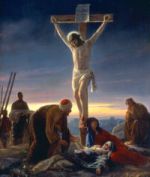
From childhood, Catholics are taught to ‘offer up’ their sufferings in union with Jesus on the Cross, for the sanctification of souls and remission of punishment due to sin. While the phrase can sometimes be misused to dismiss our personal involvement in the suffering of others, properly understood, offering up our sufferings leads to spiritual maturity and perfection.
A historian once remarked that Christ’s death on the cross was “mercifully quick”—even considering His agony in the Garden, the scourging, the crowning with thorns, and the carrying of the cross. This observation lingers and can be unsettling for the modern reader. Compared to the prolonged agony of Saint Maximilian Kolbe in Auschwitz or the enduring pain of terminal cancer patients, Christ’s suffering might seem brief. What lessons do these comparisons offer as we contemplate His Passion?
To answer, we must first recognize the many forms of suffering. A cut finger while slicing potatoes may cause only fleeting pain, yet when the adrenaline fades, the wound can throb persistently. At other times, physical pain may dissipate, but the anguish of mind and spirit lingers. Battle-weary soldiers know the haunting weight of memory, and a person facing a life-threatening illness can be consumed with worry even before the physical pain begins. Often, anticipatory suffering—the fear or anxiety experienced before the pain—can surpass the pain itself.
There is also suffering tied to building character. Many willingly endure hardship to test their resolve and abilities. Athletes, scholars, businessmen, and politicians—all who seek excellence—know this type of suffering. As St. Paul writes, “Do you not know that in a race all the runners compete, but only one receives the prize? So run that you may obtain it. Every athlete exercises self-control in all things. They do it to receive a perishable wreath, but we receive an imperishable.” (1 Cor 9:24–25) The fear of failure can be more painful than physical strain—stretched muscles, pounding hearts, or exhausted minds. An interception that costs a Super Bowl victory may haunt a player for a lifetime. But what does it profit a man to win the Super Bowl and lose his soul?
Christ’s sufferings, however, are of an entirely different order. Hints of this appear in the Gospel of St. John: “This is why the Father loves me, because I lay down my life in order to take it up again. No one takes it from me, but I lay it down on my own. I have power to lay it down, and power to take it up again. This command I have received from my Father.” (John 10:17–18) His suffering was not passive; it was an active, freely willed choice. By taking on the weight of all sins—ours, others’, and, in a mysterious way, Original Sin—Christ endured an inner suffering beyond comprehension.
If Christ’s death was comparatively “quick,” it cannot rightly be called “merciful,” for our sins are merciless. In choosing to suffer, He did not choose evil and did not sin. All suffering is inherently linked to the presence of evil, from personal quarrels to systemic injustices. In this sense, Christ’s suffering—and, by extension, all human suffering—serves as a visible sign of evil, an “anti-sacrament” contrasting with the sacraments, which are signs of grace.
From the depths of our own sinfulness, we are granted the dignity to take up the Passion of Christ with freedom and courage. “Whoever does not take up his cross and follow after me is not worthy of me.” (Matt 10:38) Suffering forces a choice: We may blaspheme, like Job’s wife, “Curse God and die.” Or we may justify evil means for good ends, like the priest Caiaphas, who argued, “…it is expedient for you that one man should die for the people, and that the whole nation should not perish.” Yet if we open ourselves to God’s grace, suffering can draw us into the heart of Christ’s mysterious Passion.
Pain and suffering naturally repel us, and most of us fail in the simplest resolutions. “But no one can tame the tongue; it is a restless evil, full of deadly poison.” (James 3:8) In the Garden, Jesus acknowledges our weakness: “The spirit is willing, but the flesh is weak.” (Matt 26:41) Still, if our spirits remain willing, meditating on His Passion strengthens our holy resolutions and empowers us to continue the arduous earthly pilgrimage. We freely accept—without resentment or despair—the unavoidable sufferings of life.
St. Paul speaks from the spiritual heights of this endeavor: “Now I rejoice in my sufferings for your sake, and in my flesh I am filling up what is lacking in the afflictions of Christ on behalf of his body, which is the church….” (Col 1:24) Later, using the metaphor of a champion, he writes: “For I am already being poured out like a libation, and the time of my departure is at hand. I have competed well; I have finished the race; I have kept the faith. From now on, the crown of righteousness awaits me….” (2 Tim 4:6–8) The Romans arrested Paul, briefly imprisoned him, tied him to a tree, and beheaded him.
If we choose, with God’s grace, to unite ourselves to Christ on the Cross, our afflictions are transformed into participation in His saving love. By joining our sufferings with His, we are sanctified and drawn deeper into His redemptive work.
United with His, our sufferings sanctify us.
Offer it up.

Fr. Jerry Pokorsky is a priest of the Diocese of Arlington who has also served as a financial administrator in the Diocese of Lincoln. Trained in business and accounting, he also holds a Master of Divinity and a Master’s in moral theology. Father Pokorsky co-founded both CREDO and Adoremus, two organizations deeply engaged in authentic liturgical renewal. He writes regularly for a number of Catholic websites and magazines. See full bio.
Next post
All comments are moderated. To lighten our editing burden, only current donors are allowed to Sound Off. If you are a current donor, log in to see the comment form; otherwise please support our work, and Sound Off!