Is the priesthood really “not about power”?
By Thomas V. Mirus ( bio - articles - email ) | Dec 17, 2025
There is an ongoing attempt to decouple the priesthood from authority, and authority from the priesthood. See, for instance, the movement to elevate laypeople to positions of authority, even authority over priests, in various Vatican dicasteries.
It is not that the clergy cannot call upon the laity to assist in Church governance. The real problem comes when the inherent connection between Holy Orders and governance is downplayed, as in discussions of ecclesiology today. If the clergy delegate some authority to laypeople, that is a matter of human convention, whereas the authority of the clergy is by divine institution. Canon law refers to this connection:
Canon 129. §1 Those who are in sacred orders are, in accordance with the provisions of law, capable of the power of governance, which belongs to the Church by divine institution. This power is also called the power of jurisdiction.
We might question arrangements which tend to obscure this reality.
The modern age distrusts as oppressive the very notion of authority, with its necessary corollary that some have more power than others by right. As a result, those who have it often try to pretend they don’t—treating authority at best as an indelicate thing, necessary, but not to be much spoken of.
It is not uncommon for priests to be somewhat embarrassed by the inequalities of authority that are built into the Church. Take the doctrine that only men can receive Holy Orders. I have seen more than one well-meaning priest defend this doctrine against feminist challenges by saying something like, “The priesthood is not about power, it’s about sacrificial service for others.”
In fairness, this line is a good way to allay fears about the abuse of power, or to dissuade people from seeking authority for the wrong reasons. But it does not answer the question of why women can’t be priests. Can’t women be suffering servants for the Church? Then why shouldn’t they aspire to this form of service?
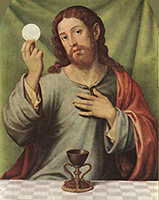
While the priesthood may not be about power in some crude and egoistic sense, it is certainly about authority. And that authority is precisely why the priest possesses the power of governance, among other powers. The hierarchy and sacramental economy of the Church are dependent on Holy Orders.
We shouldn’t try to avoid dealing with the issue of authority by downplaying it as mere “power” unseemly to desire. We must acknowledge that authority is real, that it is good, and that by necessity, it is not equally distributed. In being ordered to sacrificial service, Christian authority does not stop being authority. The head is meant to be a servant, but not merely a servant. When the Lord wanted to wash Peter’s feet, He had to command and even threaten Peter to make him allow it.
Another way of dodging the uncomfortable implications of the male-only priesthood is to avoid giving any reasons for it. We say “Christ only ordained men” and leave it at that, as though His decision were arbitrary, forgetting the maxim that grace builds on nature. To try to explain it would be to make the dangerous assertion that men and women are different.
It is true that we must receive this as revealed from on high, not subject to debate based on human reasoning. But given this datum of faith, we can and ought to say why it is fitting. To refuse to do that is to divorce faith and reason, and (I think) to be a bit parsimonious in our theology—a bit like the man who buried his talent.
The Fathers and Doctors of the Church certainly found no difficulty in giving reasons for the male priesthood, including the one everyone fears: that man has a greater capacity for authority than woman. The ministerial priesthood being pre-eminent in the Church, it is rightly reserved for the male sex, which (according to everyone from St. Paul to St. Thomas to St. Edith Stein) has and signifies a certain eminence of degree: man “is the image and glory of God; but woman is the glory of man” (1 Cor 11:7).
Likewise, in the mystical symbolism of marriage, man’s relation to woman is an image of Christ’s relation to the Church. And yes, this means that he who is pre-eminent in authority also must be the pre-eminent giver, just as Christ gives Himself and the Church receives Him. Thus the priest is given not only power to command, but power to teach and to give life through the sacraments.
Modern critics of authority are wrong to crave any power that God doesn’t want them to have, but they are not wrong to think that authority is inherently related to power. They will see through attempts to dodge the issue with false humility. Those with authority should own it, making a positive case for why it, and the power it entails, is God’s blessing not only to those who have it, but to those under it. For by the divine grace communicated by His chosen ministers to those who receive them, He gives us “power to become children of God”, co-heirs who will reign with Him forever in His kingdom.

Thomas V. Mirus is President of Trinity Communications and Editor-in-Chief for CatholicCulture.org, hosts both the Catholic Culture Podcast and Lives of the Popes, and co-hosts Criteria: The Catholic Film Podcast. See full bio.
All comments are moderated. To lighten our editing burden, only current donors are allowed to Sound Off. If you are a current donor, log in to see the comment form; otherwise please support our work, and Sound Off!