Follow Your Dreams?
By Fr. Jerry Pokorsky ( bio - articles - email ) | Sep 21, 2026
We’ve heard it said: “Follow your dreams.” But what if your dreams aren’t attainable—or useful?
We love the efficiency of indoor plumbing. High-efficiency washing machines have replaced washing clothes in the river. Who doesn’t appreciate an efficient coworker? Yet if we’re not careful, the demand for efficiency can become appalling.
Children, the elderly, and the handicapped are not efficient. But as children of God, they are never disposable. We need God’s grace to distinguish between desirable and necessary efficiency, and to recognize the inherent dignity in various forms of human inefficiency.
Efficiency is good for the economy. Henry Ford’s ingenuity is an American success story. His vision was practical. He introduced a moving assembly line that brought automobile construction to the worker. The parts were interchangeable. The work was specialized. No longer a luxury item, the automobile, beginning with the Model T, became accessible to most Americans. Henry Ford’s assembly line was efficient. His workers earned a living wage. Mission accomplished.
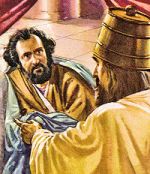
But the parable of the laborers in the vineyard (cf. Matthew 20:1–16) reminds us that God’s justice transcends human efficiency. A householder hires laborers for his vineyard. He hires them at different hours. He pays each of them the same daily wage. But the laborers grumbled at the householder, saying, “These last worked only one hour, and you have made them equal to us who have borne the burden of the day and the scorching heat.” By cost-control standards, the householder wasted his resources and provoked their envy.
The householder’s response would not pass muster with modern “best practices”: “Friend, I am doing you no wrong; did you not agree with me for a denarius [daily wage]? Take what belongs to you, and go; I choose to give to this last as I give to you. Am I not allowed to do what I choose with what belongs to me? Or do you begrudge my generosity?” “For my thoughts are not your thoughts, neither are your ways my ways, says the Lord.” (Isaiah 55:8)
The parable teaches us that God lavishes His grace upon us. He expects fidelity before efficiency. His justice is personal. He is generous. We cannot measure His justice by comparing ourselves to others. His vision may not be our vision. We all have our roles. We would do well to mind our own business.
But God expects us to use His gifts with diligence. Jesus teaches, “Every one to whom much is given, of him will much be required.” (Luke 12:48) God rewards our merits.
Some forms of Protestantism object to the concept of merit because an excessive emphasis on grace leads them to reject the Catholic understanding of meritorious works as a basis for justification. They hold that we are justified by faith apart from meritorious works. They appeal in particular to St. Paul, who writes: “For we hold that a man is justified by faith apart from works of the law.” (Romans 3:28) But Paul’s “works of the law” refer to observances that preserved the distinctive identity of the Israelites as the Chosen People bound by the Old Covenant. They include circumcision, dietary regulations, ritual purity, and other requirements.
The Law of Christ fulfills the Mosaic Law through the New and Everlasting Covenant. The universal Church forms the new People of God, no longer bound by the Mosaic practices that marked Israel’s unique identity. Good works performed in grace contribute to our growth in godly virtue, and merit a reward from God.
St. James adds: “What does it profit, my brethren, if a man says he has faith but has not works? Can his faith save him? If a brother or sister is ill-clad and in lack of daily food, and one of you says to them, ‘Go in peace, be warmed and filled,’ without giving them the things needed for the body, what does it profit? So faith by itself, if it has no works, is dead.” (James 2:14-17)
Merit consists in using the gifts God has conferred on us. Our ability to merit is itself a gift of God’s grace, which enables us to cooperate with Him and live meritorious lives in Christ. Even our response of faith is meritorious. Faith, hope, and charity are inseparable: faith directs, hope endures, and charity serves.
An analogy helps. I receive a gift from a friend and thank him. However, if I hide the gift in the closet to gather dust, I neglect the gift. If I use the gift, I not only honor my benefactor; I express my thanks in action. Our merit glorifies God as our benefactor. “Let your light so shine before men, that they may see your good works and give glory to your Father who is in heaven.” (Matthew 5:15–16)
Hence, God will not judge us by our efficiencies and accomplishments. He will judge us by how faithfully we used the gifts He has given us. Good parents demand much from their children, but sense and respect the limits of their capabilities. Efficiency may be useful on the assembly line. But we dare not measure humanity by efficiency alone. Every human being—young or old, healthy or infirm, aware or impaired—has inestimable dignity because we are God’s handiwork.
St. Paul elegantly describes our dignity as members of the Mystical Body of Christ, regardless of our worldly usefulness: “For the body does not consist of one member but of many. If the foot should say, ‘Because I am not a hand, I do not belong to the body,’ that would not make it any less a part of the body…. But as it is, God arranged the members in the body, each one of them, as he chose.” (1 Corinthians 12:14–18)
But we are not off the hook because God loves us. God expects us to serve others. So here’s some unsolicited advice: young or old, get to work. You’re not being paid to follow your dreams.

Fr. Jerry Pokorsky is a priest of the Diocese of Arlington who has also served as a financial administrator in the Diocese of Lincoln. Trained in business and accounting, he also holds a Master of Divinity and a Master’s in moral theology. Father Pokorsky co-founded both CREDO and Adoremus, two organizations deeply engaged in authentic liturgical renewal. He writes regularly for a number of Catholic websites and magazines. See full bio.
All comments are moderated. To lighten our editing burden, only current donors are allowed to Sound Off. If you are a current donor, log in to see the comment form; otherwise please support our work, and Sound Off!