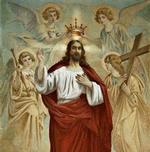
Christ the King, censored
By Thomas V. Mirus ( bio - articles - email ) | Nov 22, 2026
Praying Vespers for the Solemnity of Christ the King, I sang the hymn Te saeculorem principem. Afterward, I googled the lyrics to find an English translation. To my surprise, the text I found had some extra verses:

6. May the rulers of the world publicly honour and extol Thee; may teachers and judges reverence Thee; may the laws express Thine order and the arts reflect Thy beauty.
7. May kings find renown in their submission and dedication to Thee. Bring under Thy gentle rule our country and our homes.
These were part of the original hymn written in 1925 when the feast of Christ the King was established by Pope Pius XI. In 1970, when the Divine Office was reformed into the modern Liturgy of the Hours, the verses were removed. Not only that, but other verses were changed along similar lines. The first half of verse 2, below, was removed:
The wicked mob screams out, “We don’t want Christ as king,” while we, with shouts of joy, hail Thee as the world’s supreme King.
And a line in the final verse was changed so that Jesus, rather than being said to “rule the scepters of the world” as in the original, is said to “rule all things with love.”
Thus, as it stands in today’s Liturgy of the Hours, the hymn omits all reference to the reign of Christ over states and rulers.
Looking into these changes further, I found an article by the late Michael Davies detailing how the liturgical reformers deliberately and systematically removed references to the social kingship of Christ from the texts of the Mass and the Divine Office.
The perversity of this censorship is heightened by an awareness of this solemnity’s origins. The very reason Pius XI instituted the feast in his encyclical Quas Primas was, in the face of the new totalitarian secular ideologies making an idol of the state, specifically to affirm the rule of Christ not only over individual souls, or over humanity at the end of time, but over states and the social order here and now. Just 45 years after the feast was established, its original meaning was suppressed and given an undue eschatological emphasis.
The texts in question were doubtless thought incompatible with the teaching on religious freedom found in Vatican II’s Dignitatis Humanae. And while one might disagree with Davies about whether Dignitatis Humanae strictly contradicted the prior doctrine of the social kingship of Christ, we can see clearly how that document was implemented in the very lex orandi which, more than any conciliar document, forms how the clergy and laity see the Church’s mission in the world.
The altered versions of the hymns in the current Liturgy of the Hours for Christ the King are fine hymns to sing. As with the Novus Ordo Missal, there is (contrary to some traditionalists) nothing in their content that is harmful or contrary to faith, and indeed they remain edifying and meritorious prayers. But, as I wrote last year about the removal of the Dies irae and the imprecatory psalms, it is deeply troubling that important aspects of the Catholic faith have been removed from sight not only in common preaching but on the official level of liturgy.
God, in His unsearchable ways, has allowed these things to happen to His Church. It is by His sovereign will that He allows His sovereignty to be ignored and denied. Perhaps, on this feast, it is appropriate to end abruptly on that point rather than to propose a solution. For to recognize that He already governs all things is the solution without which all lesser solutions become an assertion of our kingship rather than His.

Thomas V. Mirus is President of Trinity Communications and Editor-in-Chief for CatholicCulture.org, hosts both the Catholic Culture Podcast and Lives of the Popes, and co-hosts Criteria: The Catholic Film Podcast. See full bio.
Next post
All comments are moderated. To lighten our editing burden, only current donors are allowed to Sound Off. If you are a current donor, log in to see the comment form; otherwise please support our work, and Sound Off!