A new Christmas ballet with the sacred at its core
By Thomas V. Mirus ( bio - articles - email ) | Dec 11, 2025
As a holiday that’s existed for almost two millennia, celebrated around the world, Christmas has generated an amazing diversity of customs and aesthetic modes. Some reach right to the core of the sacred mystery, others are more tangential in a festive overflow.
Unfortunately, America’s public culture of Christmas is confined to the sentimental, the secular, and the saleable. Outside of some homes and churches, our customs no longer capture the solemnity and the authentic spiritual joy of the Nativity.
When it comes to high culture, Handel’s Messiah is still a popular Christmas performance tradition. But even in your local concert hall, there might not be not much else that rates high on the reason-for-the-season-ometer.
There is a refreshing exception, though, for those lucky enough to live in the environs of Hartford, Connecticut. Ballet Hartford has developed a program celebrating Christmas in all its beloved dimensions, but with the sacred at its core: not only the warmth of cultural nostalgia, but the historical event of the Nativity, and something a bit otherworldly too—under the title A Ceremony of Carols: A New Christmas Tradition.

A bit of background: Three years ago, Claire Kretzshmar retired as a soloist ballerina with the New York City Ballet, in order to focus on teaching and choreography. Almost immediately she began doing very ambitious work—in 2024, she choreographed the full-length ballet Raffaella, a fairy tale with Catholic themes (which I reviewed after its premiere in South Bend).
In the meantime, she found a more stable home as artistic director at Ballet Hartford in Connecticut. Her choreography there has been largely focused on developing a completely new Christmas program that will be core to the company’s repertoire for years to come, with a new piece being added every year since 2023. First came A Ceremony of Carols, then Weihnachtsbaum (‘Christmas Tree’). Now the program has been completed with a third piece, Notte di Natale (‘Christmas Night’), which received its world premiere in Hartford on November 29.
In an introductory note, Kretzschmar describes the program:
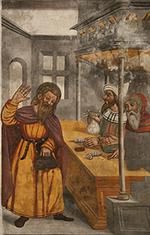
Notte di Natale is the heart of this new tradition, carefully nestled between two ballets that capture more of the feelings of Christmas. Weihnachtsbaum is like the joy of a holiday party, A Ceremony of Carols presents a heavenly and angelic celebration of Christmas. Notte di Natale is grounded right between the two, with the most concrete storytelling among the trio. Its six movements travel from the moment that the Angel Gabriel announces to Mary the birth of the Son of God all the way to the Adoration of the Magi, where even three wise kings pay tribute to Mary’s newborn baby.
Weinachtsbaum is a lesser-known piano suite by Franz Lizst, simpler and easier to play than most of his works. It comprises twelve pieces, some based on Christmas carols like “In dulci jubilo” and “Adeste fideles”, in restrained yet clever and charming arrangements. Kretzschmar’s ballet, lasting about a half hour, includes eight of these movements, with the dancers dressed as for an old-fashioned Christmas ball. Lizst’s often low-key music is a great way of easing into the program.

Notte di Natale, the narrative ballet of the Nativity, is set to a baroque concerto by Arcangelo Corelli, which was first performed in the Apostolic Palace in the presence of Pope Alexander VIII on Christmas Eve, 1690 (you may recognize the music from Master and Commander). It is the shortest ballet on the program but has the biggest cast, since it includes not only a large suite of angels, but (delightfully) the children of the School of Ballet Hartford playing shepherds, Magi, and livestock.


Notte di Natale was especially a showcase for Maggie Bucko, who danced the part of Mary with great finesse but also an earthy exuberance that makes one think of how David might have danced before the Ark—especially in her dance near the beginning with Elizabeth (Molly McGuerty), for me the standout performance of the night. She modulated this for gentler and more restrained movements when dancing while holding the baby Jesus, with only one arm free to partner with Joseph (Daniel Cooke). The choreography between Mary and Joseph (both Bucko and Cooke are Catholic, by the way) effectively conveys a tender, intimate but chaste espousal.

A Ceremony of Carols (my favorite ballet on the program, perhaps just because I’ve seen it the most times) is set to a suite for voices and harp by the important English composer Benjamin Britten. Like many other European countries at the time of burgeoning nationalism, nineteenth-century England had seen a revival of interest in folk traditions, as well as a Romantically inspired revival of interest in medievalism and the English carol tradition in particular, with composers like Vaughn Williams and Holst writing new carols in medieval style. Britten, in the mid-twentieth century, followed in that tradition with a number of gorgeous carol arrangements blending medieval and modern styles (his “Corpus Christi Carol” is probably my favorite—it was most famously performed by Jeff Buckley, but here is a choral version).
The texts in A Ceremony of Carols include a number of well-known Middle English poems (like “There is no rose of such vertu”), as well as two poems by the Jesuit martyr St. Robert Southwell. Britten’s music is somehow both ethereal and earthy at the same time, with high children’s voices singing pretty yet unsettling harmonies, but also some rather head-bopping rhythms.
This uncanny feeling serves the ballet’s concept of an angelic celebration, since the depiction of angels in Scripture tends to be a bit unnerving. But these otherworldly spirits are in a solemnly playful rather than intimidating mode, as the dance reflects. It is the ensemble that stands out in this ballet: from my layman’s perspective one of Kretzschmar’s strengths as a choreographer is her creation of a dynamic architecture with groups of bodies. Another is her sensitivity to musical detail, on display throughout the program.

I am given to understand that ballet can be a rough business and that dancers are not always treated well. Having spoken to a number of the dancers at Ballet Hartford, it’s evident that Kretzschmar has fostered a healthy, caring, and inspiring atmosphere at the company. In an edifying conversation, one dancer conveyed to me a palpable sense of relief at having landed there, by contrast with previous professional experiences. I suspect that this approach manifests itself in the School of Ballet Hartford as well, which would make it a good option for local parents looking for a dance school for their children.
As a small company, Ballet Hartford has only had the budget for one performance of their Christmas program this year. But it will be an annual event, and they hope to expand their performance schedule in 2026. I encourage those in the Connecticut area to keep an eye on Ballet Hartford’s doings.

Thomas V. Mirus is President of Trinity Communications and Editor-in-Chief for CatholicCulture.org, hosts both the Catholic Culture Podcast and Lives of the Popes, and co-hosts Criteria: The Catholic Film Podcast. See full bio.
All comments are moderated. To lighten our editing burden, only current donors are allowed to Sound Off. If you are a current donor, log in to see the comment form; otherwise please support our work, and Sound Off!