AI and Authentic Christian Dignity
By Fr. Jerry Pokorsky ( bio - articles - email ) | Jan 12, 2026
The baby boomer generation is probably struggling to keep up with the wizardry of Artificial Intelligence (AI). We may discover that grammar checkers improve writing, like an examination of conscience, by directing thoughtful writers to their predominant faults. But relying too much on AI may ruin one’s ability to write good. AI applications have become elaborate encyclopedias, responding at lightning speed to our requests for information. Yet AI has its inherent limits. The Baptism of the Lord helps us contrast the dignity of our humanity with the capabilities of AI technology.
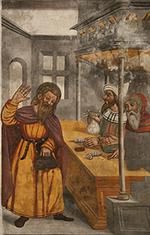
Water gives life, and water destroys. Water also refreshes our drooping spirits, renews the face of the earth, and gives life to all. The waters of the Great Flood destroyed the earth in the time of Noah. The storms of the sea pose a threat to seafarers. Water destroys laptop computers. The Baptism of the Lord is another epiphany—a manifestation of Jesus as the Son of God—using the symbolism of water.
The Baptism of Jesus fulfills the prophecy of Isaiah. As God and man in the Incarnation, Jesus takes our humanity unto Himself. In Baptism, our sinful humanity, in union with His sacred humanity, dies in the waters of baptism. In Christ, our humanity rises from the baptismal waters with Him. The Baptism of Jesus foreshadows the Cross and the Resurrection, and it foreshadows our own baptism.
In Christ, the descent of the Holy Spirit sanctifies our humanity and foreshadows the Sacrament of Confirmation. In Christ, the heavenly voice declaring, “This is my beloved Son, in whom I am well pleased,” also applies to us, His adopted sons in Baptism.
Our baptismal promises renounce Satan and profess our belief in Jesus and the Church. Baptism obliterates the stain of Original Sin, although sinful inclinations remain. Baptism confers the dignity of sanctifying grace and incorporates us into the Mystical Body of Christ, the Church. In Jesus, every human person is a child of God. By Baptism, God claims us as adopted sons in the Son and as holy instruments in union with Himself and His Church.
Jesus built the Church on the rock of St. Peter and the Apostles. After His Ascension into heaven with the descent of the Holy Spirit upon Mary and the disciples, the Church was born. We become members of the Mystical Body of Christ by Baptism and are sealed by the Holy Spirit in Confirmation. The Ascension and Pentecost—the descent of the Holy Spirit upon Mary and the disciples—are critical to our understanding of the Catholic faith and our Christian duties. Jesus, by grace, is not an absentee landlord. But neither is He a Divine Answer Man.
Jesus says, “If you love me, you will keep my commandments.” (John 14:15) Love God. Love neighbor. Do not look lustfully at a woman lest you commit adultery in your heart. Judge not the heart of man, and you will not be judged. His commandments are precious few. We might finish all four Gospels in an afternoon. Jesus did not leave a detailed code of behavior, like the American tax code, to guide our every action. Instead, Jesus gives His Church the dignity of developing a body of teaching, under the guidance of the Holy Spirit, that provides the first principles of life in Christ.
We apply those principles to the circumstances of our lives according to our wits as we invoke the Gifts of the Holy Spirit. A Catholic who understands his baptismal dignity asks, “What does the Church teach, and how can I apply that teaching under these particular circumstances? How can I be a holy and virtuous instrument of Jesus?”
These Christian principles were developed under the guidance of the Church over the centuries. With the assistance of the Holy Spirit, we apply them according to our individual circumstances while retaining our freedom. We grow in virtue and continue to overcome the remnants of Original Sin that afflict us until we enter heavenly glory.
An encyclopedia is a thing. It cannot receive God’s grace. It cannot be virtuous. It can only provide information. With the Gifts of the Holy Spirit, our intellect enlightened and our will fortified by grace, we carry out God’s will in freedom. With God’s grace, in union with His Mystical Body, we become His instruments.
We may ask an encyclopedia—or AI—“What does the Church teach?” But we would not ask an encyclopedia—or AI—“What would Jesus do?” Artificial intelligence cannot substitute for the grace God applies to our souls. Jesus is not an Answer Man, an Oracle of Delphi, an Encyclopedia Britannica, or a tax code. When we reduce moral discernment to the question “What would Jesus do?” we risk surrendering our freedom to technology and to so-called experts.
Catholics are not immune to this temptation. We sometimes view priests as spiritual oracles. Instead of asking, “What does the Church teach?” we may ask a priest in spiritual direction, “What should I do?” There is usually no harm in obtaining advice. Indeed, it is far easier for a priest to tell a penitent what not to do. (The sins clustered under the Ten Commandments, in the grand scheme, are limited.) But the number of virtuous options subject to our prudence is unlimited, and prudence is a virtue that cannot be delegated. A person striving to be virtuous does not ask, “What would Jesus do?” nor does he ask his priest to be his private answer man.
That question also suggests that for every set of circumstances, there is only one correct answer. It reduces Jesus to the Answer Man, the go-to authority for prepackaged solutions. In doing so, we risk denying our status as members of His Mystical Body, refusing to cooperate with the movements of His grace, and wounding our Christian freedom and dignity—or so it seems to me.
A mature Christian asks, “What does the Church teach?” and, with God’s grace, “How can I carry out my baptismal promises as an upright and honorable instrument of God?”
Fr. Jerry Pokorsky is a priest of the Diocese of Arlington who has also served as a financial administrator in the Diocese of Lincoln. Trained in business and accounting, he also holds a Master of Divinity and a Master’s in moral theology. Father Pokorsky co-founded both CREDO and Adoremus, two organizations deeply engaged in authentic liturgical renewal. He writes regularly for a number of Catholic websites and magazines. See full bio.
All comments are moderated. To lighten our editing burden, only current donors are allowed to Sound Off. If you are a current donor, log in to see the comment form; otherwise please support our work, and Sound Off!