The Guardian of the Covenant
By Fr. Jerry Pokorsky ( bio - articles - email ) | Dec 22, 2025
In commerce, parties engage in trade agreements. Nations make treaty agreements. Every agreement enhances mutual understanding. Some even prevent war. Throughout Scripture, God also enters into trade agreements with man.
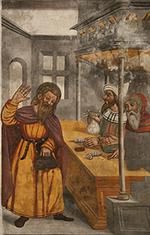
At first glance, St. Joseph may appear to occupy a relatively obscure role as a negotiator in the Gospels, but the account of the angel Gabriel appearing to Joseph establishes him as a key negotiator on our behalf in God’s providence.
In the Book of Genesis, God witnesses the marriage between Adam and Eve. Adam delights in his new bride during his honeymoon: “At last, bone of my bone and flesh of my flesh!” God establishes a covenant with our First Parents and gives them the gift of the fruit of the tree of everlasting life if they agree to obediently avoid the tree of the knowledge of good and evil. A good deal, when you think of it. In perfect goodness, why would they want to know anything about evil? God honored His side of the bargain. But Adam and Eve broke the agreement and brought sin, suffering, and death into the world.
The descendants of Adam swirled down the maelstrom of evil—to put it indelicately—due to sins of their own making. Cain murdered Abel. When God destroyed the world in the great flood, except for the just man Noah and his family, He affixed a rainbow in the sky as a witness to the one-sided divine promise never to destroy the world again. All of His covenants are lopsided in our favor. He promised the faithful Abraham that he would be the father of many nations.
During the Exodus, the Ten Commandments represented God’s trade agreement with His chosen people, complete with a list of terms. Obey these commandments, and you will not be slaves to dishonor, murder, impurity, theft, and lies. God said, “You shall be my people, and I shall be your God.” No catches. They would become the vehicle for His sacred Revelation and prefigure the Catholic Church.
God offers Mary a sweetheart deal. The negotiations begin with the recognition of Mary’s undeniable strengths. The Angel Gabriel appears to Mary in a vision and hails her as “full of grace”—permeated in her entirety with sinlessness from the moment of her conception. Although betrothed to Joseph but before they lived together, Mary asks the Angel to clarify his terms: “How can this be, since I do not know man?” Gabriel responds, “The Holy Spirit shall descend upon you, and you will conceive.” Deal struck. And the Word was made flesh and dwelt among us.
In the grand finale of God’s covenantal negotiations with His people, Jesus took the bread, blessed it, gave it to His disciples, and said: “Take this, all of you, and eat of it, for this is my Body, which will be given up for you.” And, “Take this, all of you, and drink from it, for this is the Chalice of my Blood, the Blood of the New and Eternal Covenant, which will be poured out for you and for the forgiveness of sins.” Then our part: “Do this in memory of me.”
The New and Everlasting Covenant fulfilled every trade agreement God made with His people. At every Mass, we re-present and work out that covenant in obedience to its terms.
The New and Everlasting Covenant provides the components of every human agreement made in good faith. The agreement must be honest and just; its words accepted as true and binding; and its terms faithfully executed. The New and Everlasting Covenant of the Mass is the perfect exemplar of every human covenant, especially marriage: honesty, sacrifice, generosity, exclusivity, and indissolubility.
The marriage covenant fulfilled by Jesus in the New and Everlasting Covenant brings us back to the Garden of Eden. With God’s grace, faithful marriages restore the marriage covenant that Adam and Eve defaced. After the Fall, the original unity of man and woman was shattered. The world came to know alternating forms of male and female domination, from polygamy to temple prostitution. (Check your history books!) By the time of Mary’s yes to the Angel, marriage was between one man and one woman, with God “hating divorce.”
Hence it is not insignificant that Joseph considered divorce when he learned Mary was with child. Although Joseph knew Mary’s virtue and virginity, he could not be expected to understand the circumstances without a special revelation. The angel Gabriel appears once again in a dream and instructs Joseph not to divorce Mary, because she conceived by the power of the Holy Spirit. Gabriel even gave Joseph the dignity of naming the child Jesus, the Savior, who would save the people from their sins.
Mary’s obedience makes her the new Eve, with Jesus as the new Adam. But Mary’s earthly marriage to Joseph, her most chaste spouse, was another inviolable covenant of its own. By Joseph’s faithful obedience to the angel Gabriel, Joseph protected the marriage covenant he shared with Mary. Mary joins her fidelity to Joseph to the obedience of Jesus on the Cross. The chaste marriage covenant between Mary and Joseph became the faithful gateway to the New and Everlasting Covenant. What God has joined, men must not divide.
Covenants are communal, respectful, mutually advantageous, fruitful, and protective of human freedom and dignity. Married folks might ask themselves, as they brush their teeth in the morning, this: “What am I doing to dishonor, undermine, and harm my marriage covenant?” Put another way: “What can I do to honor, enhance, and protect my marriage covenant? How might we bring our fidelity to the New and Everlasting Covenant of the Mass?”
Just as Mary’s faithful fiat sealed her covenant with the Holy Spirit, Joseph’s obedience sealed his sacred covenant with Mary. God’s intervention in history is always a good deal. When circumstances tempt us to renege on holy promises, we may invoke Mary’s intercession, and we may add: St. Joseph, Guardian of the Covenant, pray for us.
Fr. Jerry Pokorsky is a priest of the Diocese of Arlington who has also served as a financial administrator in the Diocese of Lincoln. Trained in business and accounting, he also holds a Master of Divinity and a Master’s in moral theology. Father Pokorsky co-founded both CREDO and Adoremus, two organizations deeply engaged in authentic liturgical renewal. He writes regularly for a number of Catholic websites and magazines. See full bio.
All comments are moderated. To lighten our editing burden, only current donors are allowed to Sound Off. If you are a current donor, log in to see the comment form; otherwise please support our work, and Sound Off!