The Catholic Rubik’s Cube
By Fr. Jerry Pokorsky ( bio - articles - email ) | Apr 20, 2026
Fundamentally, every human being has one purpose in life: to figure out reality. There are two aspects to our God-given quest. What narrative makes the most sense—and how do I fit within it? The Rubik’s Cube is a helpful metaphor.
A Rubik's Cube is a handheld 3D puzzle composed of colored squares. Each face of the cube is one solid color when solved. The goal is to twist and turn the layers until each face is back to a single, uniform color. Despite its simple appearance, it’s surprisingly complex.
Like life.
The great philosophers introduce their version of the puzzle. Their familiar insights attempt to explain reality. Socrates: “The unexamined life is not worth living.” An honest examination of conscience is good for the soul. Søren Kierkegaard: “Life must be understood backward. But it must be lived forward.” We recognize God’s providence through the events of our lives.
Other philosophical doctrines are less appealing to us commoners:
René Descartes: “I think, therefore I am.” Descartes sought to overcome doubts. Still, we might ask whether it is more reasonable to say, “I cannot think if I don’t exist.”
John Stuart Mill defends human liberty to avoid harm: “Liberty is doing what you want.” Nevertheless, experience shows that unchecked desires can enslave us—as seen in those painful detox units.
Friedrich Nietzsche: In the face of suffering and disillusionment, Nietzsche declared that “God is dead.” Yet the beauty of creation—and the persistent human search for purpose and moral accountability—provides too much evidence to accept the conclusion.
The Christian Rubik’s Cube reveals the compatibility of faith and reason, heaven and history, body and soul. It is a far more appealing explanation of reality.
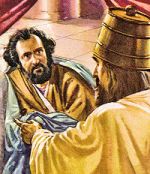
After the Resurrection, Jesus makes an anonymous appearance to a group of disciples on the way to Emmaus (cf. Luke 24:13-34). During the journey, He conducts a Bible study. He explains the Scriptures foretold that the Messiah had to suffer before entering into glory. Beginning with Moses and all the prophets, He interprets the passages concerning Himself.
God’s revelation to the Chosen People prepared the way for Christ. Jesus is a friend of history. The Apostles’ Creed has its roots in the Bible study on the road to Emmaus. The Creed narrates our understanding of creation, from beginning to eternity.
Theological studies deepen our understanding of the facts of faith. The chosen Twelve Apostles rise above the Twelve Tribes of Israel and every nation. Before the Church was identified as Catholic, it was simply “the Way.” Or, the “Way of Life” (the Didache). Those baptized in Christ have become the universal Chosen People.
The Creed, the Sacraments, the Ten Commandments, and prayer provide the unifying facets of the Catholic Faith. With public revelation ending with the death of the last Apostle, the quest to accurately express the sacred deposit of the faith in doctrinal formulations continues. Faith seeking understanding is a lifetime quest.
The Catholic faith is forever reasonable, but many mysterious realities are beyond our reach. Even the greatest of theologians fall short in working the Rubik’s Cube of God’s revelation.
Near the end of his life, after a profound mystical experience while celebrating Mass, St. Thomas Aquinas stopped writing. When urged to continue his great work, the Summa Theologica, he said, “All that I have written seems like straw to me compared to what has now been revealed to me.” A complete picture of the Catholic faith will not be manifest in its perfection until heavenly glory.
We also have our unique puzzles as we work out our salvation. God created us to know, love, and serve Him. Our knowledge of faith is only the beginning of personal sanctity. St. John Henry Newman invokes the Gospel principle that “to whom much is given, much will be required.” (Luke 12:48) The story goes that when he was asked whether being a great theologian makes him a great saint, he replied: “No, it merely makes him more accountable on the Day of Judgment.”
Atheists are not impressed. Fair enough. However, disbelief does not exempt one from the obligation to provide a coherent account of reality—and to live accordingly. Like Christians, atheists also grapple with mystery. If death truly extinguishes human existence, why would an atheist admire—rather than ridicule—self-sacrifice, such as a fireman giving his life to save a child? A Christian would say that even those who reject God are still attracted to selfless acts—because they are made in the image of a generous God.
The Church teaches that God exists and He is our destiny. She rejoices in humanity—including atheists—as she prays for the world on Good Friday, the day the Son of God died. The Church’s Good Friday prayers remind us that God’s love for humanity is not sectarian. She prays for the Church, those preparing for Baptism, the Jews, religious non-Christians, atheists, and the entire world.
Jesus suffered and died for all of us—not merely for a predestined handful rescued from the mass of the damned. Jesus fulfills Israel's history of faith, and members of His Mystical Body are the new People of God, the Chosen People. Unlike the emphasis on God’s transcendence in Islam, Christianity proclaims the reconciliation of God and man in Jesus and His Church. Unlike many forms of Hindu belief that include cycles of reincarnation, Christianity teaches that we have one lifetime to prepare for our eternal destiny, for better or worse.
With God’s grace, at every Mass throughout the liturgical year, like those disciples on the Road to Emmaus, we recognize Jesus anew “in the breaking of the bread.” The Catholic Rubik’s Cube comes down to a simple truth that promises to solve every puzzle in life: “I am the way and the truth and the life. No one comes to the Father except through me.” (John 14:6)
Fr. Jerry Pokorsky is a priest of the Diocese of Arlington who has also served as a financial administrator in the Diocese of Lincoln. Trained in business and accounting, he also holds a Master of Divinity and a Master’s in moral theology. Father Pokorsky co-founded both CREDO and Adoremus, two organizations deeply engaged in authentic liturgical renewal. He writes regularly for a number of Catholic websites and magazines. See full bio.
All comments are moderated. To lighten our editing burden, only current donors are allowed to Sound Off. If you are a current donor, log in to see the comment form; otherwise please support our work, and Sound Off!