Ordinary Time: October 7th
Memorial of Our Lady of the Rosary
Other Commemorations: St. Mark, Pope and Confessor (RM); Sts. Sergius and Bacchus, Martyrs (RM)
Free eBook:
|
| Free eBook: Liturgical Year 2023-2024, Vol. 4 |
MASS READINGS
October 07, 2011 (Readings on USCCB website)
COLLECT PRAYER
Lord, fill our hearts with your love, and as you revealed to us by an angel the coming of your Son as man, so lead us through his suffering and death to the glory of his resurrection, who lives and reigns with you and the Holy Spirit, God, for ever and ever. Amen.
Recipes (6)
Activities (18)
Prayers (5)
Library (16)
Blog & Podcasts (7)
» Enjoy our Liturgical Seasons series of e-books!
The feast of Our Lady of the Rosary was instituted to honor Mary for the Christian victory over the Turks at Lepanto on October 7, 1571. Pope St. Pius V and all Christians had prayed the Rosary for victory. The Rosary, or the Psalter of the Blessed Virgin Mary, is one of the best prayers to Mary, the Mother of God.
Pope Benedict XVI invites all families to pray the Rosary for the intentions of the Pope, the mission of the Church and peace. "It is as if every year Our Lady invited us to rediscover the beauty of this prayer, so simple and profound." The Rosary, a "contemplative and Christocentric prayer, inseparable from the meditation of Sacred Scripture," is "the prayer of the Christian who advances in the pilgrimage of faith, in the following of Jesus, preceded by Mary," said the Pontiff.
According to the 1962 Missal of Bl. John XXIII the Extraordinary Form of the Roman Rite, today is also the feast of St. Mark, who succeeded St. Sylvester and was pope for eight months during Constantine's reign. He zealously continued the great work of Church organization made possible by the period of freedom from persecution due to the Emperor's conversion. He built two churches in Rome, one of which, the titulus Marci, has become the church of St. Mark, and still exists. He died in 336.
Our Lady of the Rosary
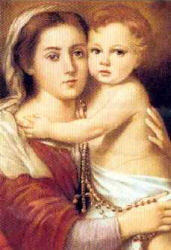 This feast was instituted by Pope St. Pius V in thanksgiving for the great naval victory over the Turks at the battle of Lepanto on this day in the year 1570, a favor due to the recitation of the Rosary. This victory saved Europe from being overrun by the forces of Islam.
Lepanto, perhaps the most complete victory ever gained over the Ottoman Empire, on October 7, 1571, is commemorated by the invocation "Help of Christians," inserted in the Litany of Loretto. At Belgrade, the Turks were defeated on the Feast of Our Lady ad Nives in 1716. A second victory gained that year on the Octave of the Assumption determined Pope Clement XI to command the Feast of the Rosary to be celebrated by the universal Church. Leo XIII added the invocation "Queen of the most Holy Rosary, pray for us," to the Litany of Loretto. The Feast is in reality a great festival of thanksgiving for the signal and countless benefits bestowed on Christendom through the Rosary of our blessed Queen.
In modern times successive popes have urged the faithful to pray the Rosary. It is a form of contemplative prayer, mental and vocal prayer, which brings down God’s blessing on the Church. It is a biblically inspired prayer that is centered on meditation on the salvific mysteries of Christ in union with Mary, who was so closely associated with her Son in his redeeming activity.
Highlights and Things to Do:
- Pray the Rosary, or 5 decades of the Rosary tonight with your family. Continue this practice through October, the month that is especially dedicated to the Rosary.
- Read the encyclicals on the rosary, and Pope St. John Paul II's last apostolic letter on the rosary from 2002.
- Learn the Luminous Mysteries. For families with younger children, it helps to have visual aids for the mysteries. Have a picture to flip at the beginning of each decade for the family Rosary. See the Activities Bar for ideas.
- Learn how to make rosaries, cord and/or wire for missions.
- Learn about the great victory of Our Lady at the Battle of Lepanto. You can also read more about Pope St. Pius V, who instituted the Feast of Our Lady of the Rosary.
- Read more about Our Lady of the Rosary:
- Read Cardinal Angelo Sodano's homily at the Shrine of Our Lady of the Rosary.
- "The Rosary, or Psalter of the Blessed Virgin Mary, is one of the most excellent prayers to the Mother of God." Read the Directory on Popular Piety and Liturgy on the Rosary, particularly encouraging the practices of:
- [T]he recitation of the Rosary could be made more solemn in tone "by introducing those Scriptural passages corresponding with the various mysteries, some parts could be sung, roles could be distributed, and by solemnly opening and closing of prayer."
- The custom of making an insertion in the recitation of the Hail Mary, which is an ancient one that has not completely disappeared, has often been recommended by the Pastors of the Church since it encourages meditation and the concurrence of mind and lips.
Insertions of this nature would appear particularly suitable for the repetitive and meditative character of the Rosary. It takes the form of a relative clause following the name of Jesus and refers to the mystery being contemplated. The meditation of the Rosary can be helped by the choice of a short clause of a Scriptural and Liturgical nature, fixed for every decade.
- Foods for this feast: Since the origin of this feast came from the Christian fleet defeating the Turks at the Battle of Lepanto in 1570 through the intercession of Mary through the Rosary, why not make a cake in the shape of a ship? See the top bar for a cut-out cake, or make moderations to this Pirate Ship Cake. Read more about the Battle of Lepanto for ideas.
- St. Pius V was a very holy Dominican, who wore his scratchy habit underneath his papal robes, and walked around Rome barefoot. He ate just to sustain himself and fasted frequently. We should use his example and remember to fast and pray the Rosary for the conversion of Islam.
- See Catholic Cuisine for some feast day food ideas.
St. Mark
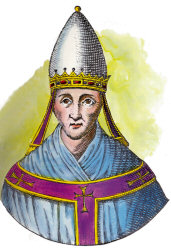 Prominent among the clergy, Mark, the son of Priscus, was elected to the See of Rome just eighteen days after the death of St. Sylvester. A Roman, Mark was described as a man who was "filled with the love of God, the guardian of justice, a true friend of Christ."
Mark is credited with instituting the ancient custom of a pope being consecrated by the bishop of Ostia. He is also said to have issued an edict whereby the bishops of Ostia were granted the pallium by the pope. The pallium, a circular band of wool, is the symbol of apostolic power worn by the pope; when it was bestowed on an archbishop, it symbolized his participation in that power.
Mark's pontificate, although short, occurred during times of great change. The heretic Arius was dying, nevertheless, his followers continued to grow in strength in the East, and as a result, such great leaders of the orthodoxy as Athanasius of Alexandria were deposed. Emperor Constantine still reigned, and he was no less generous toward the new pope. He bestowed on Mark two more basilicas: one in the cemetery of Balbina on the Via Ardeatina; and the other, the church of St. Mark, originally named for the pope.
Mark died peacefully on October 7, 336, the same year in which he was elected. He was buried in a place of his own choosing, the cemetery of Balbina.
—Excerpted from The Popes: A Papal History, J.V. Bartlett
Highlights and Things To Do:
- Read more about Pope St. Mark:
- St. Mark's remains were translated from the Catacomb of Balbina, to an urn below the main altar of San Marco Evangelista al Campidoglio, Rome.
Sts. Sergius and Bacchus
 Sergius and Bacchus were martyrs under the Diocletian persecution around the year 303 A.D. Legend states that Sergius was an officer in the Roman army and Bacchus an officer under him, and both were friends of Emperor Maximian. When they did not enter the temple of Jupiter with the Emperor, he ordered them to do so. When they further refused his order that they sacrifice to pagan gods, they were humiliated by being led through the streets of Arabissus in women's garb. Maximian then sent them to Rosafa, Mesopotamia, where they were scourged so terribly that Bacchus died of the scourging. Sergius was then tortured further and beheaded.
Symbols and Representation: Former with cross; white shield with gold cross fleuree; scourges.
Highlights and Things to Do:
- Read more about these martyrs from the Catholic Encyclopedia.
- Sergius was a very popular saint in Syria and Christian Arabia. The city of Resafa, which became a bishop's see, took the name Sergiopolis and preserved his relics in a fortified basilica. Resafa was improved by Emperor Justinian and became one of the greatest pilgrimage centers in the East. See this site for more images
- The Roman Titular Church of Sts. Sergius and Bachus has been a national Ukrainian Greek Church since the 1970s, and was known officially as the "Parish of Ukrainian Catholics of Madonna del Pascolo and Saints Sergius and Bacchus." Since 2019 the church serves as a cathedral for the Ukrainian Catholic Apostolic Exarchate of Italy.
- The feast day of Sts. Sergius and Bacchus has been traditionally celebrated on October 7 in the West, marking the day of their martyrdom. They shared the day with Pope St. Mark and Sts. Marcellus and Apuleius. When October 7 became the feast of Our Lady of the Rosary, and the commemorations of Sergius, Bacchus and the other saints were moved to October 8, but restored to October 7 with the 1969 liturgical calendar reform.