Month of the Holy Rosary


 Joyful
Mysteries
Joyful
Mysteries Visitation
Nativity of Christ
Presentation of the Christ Child in the Temple
Finding of the Christ Child in the Temple
Sorrowful
MysteriesScourging at the Pillar
Crowning with Thorns
Carrying of the Cross
Crucifixion
Glorious
MysteriesAscension
Descent of the Holy Spirit
Assumption
Coronation of Mary
Luminous
Mysteries Manifestation of Jesus at the Wedding at Cana
Proclamation of the Kingdom of God
Transfiguration of Jesus
Institution of the Eucharist
On the Most Holy Rosary — Rosarium Virginis Mariaei — Apostolic Letter of Pope John Paul II
For the Right Ordering and Development of Devotion to the Blessed Virgin Mary — Encyclical of Paul VI
Encyclical on the Rosary — Encyclical of John XXIII
On
Reciting the Rosary
— Encyclical of Pius XII
On the Rosary — Encyclical of Pius XI
On the Devotion of the Holy Rosary — Encyclical of Leo XIII
On the Rosary -- Encyclical of Saint Pius V
On the Rosary — by St. Louis de Montfort
The Rosary (Catholic Encyclopedia)
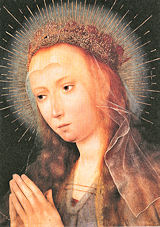
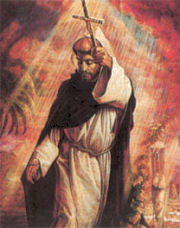
The month of October (Overview - Calendar) is dedicated to the Holy Rosary. According to an account by fifteenth-century Dominican, Alan de la Roch, Mary appeared to St. Dominic in 1206 after he had been praying and doing severe penances because of his lack of success in combating the Albigensian heresy. Mary praised him for his valiant fight against the heretics and then gave him the Rosary as a mighty weapon, explained its uses and efficacy, and told him to preach it to others.
 "Since
the prayers of the Rosary come from such excellent sources — from
Our Lord Himself, from inspired Scripture, and from the Church —
it is not surprising that the Rosary is so dear to our Blessed Mother
and so powerful with heaven.
"Since
the prayers of the Rosary come from such excellent sources — from
Our Lord Himself, from inspired Scripture, and from the Church —
it is not surprising that the Rosary is so dear to our Blessed Mother
and so powerful with heaven.
"If we consider the power of the Rosary as seen in its effects, we find a great abundance of proofs of its wonderful value. Many are the favors granted to private individuals through its devout recitation: there are few devoted users of the Rosary who cannot testify to experiencing its power in their own lives. If we turn to history, we see many great triumphs of the Rosary. Early tradition attributes the defeat of the Albigensians at the Battle of Muret in 1213 to the Rosary. But even those who do not accept this tradition will admit that St. Pius V attributed the great defeat of the Turkish fleet on the first Sunday of October, 1571, to the fact that at the same time the Rosary confraternities at Rome and elsewhere were holding their processions. Accordingly, he ordered a commemoration of the Rosary to be made on that day. Two years later, Gregory XIII allowed the celebration of a feast of the Rosary in churches having an altar dedicated to the Rosary. In 1671, Clement X extended the feast to all Spain. A second great victory over the Turks, who once, like the Russians, threatened the ruin of Christian civilization, occurred on August 5, 1716, when Prince Eugene defeated them at Peterwardein in Hungary. Thereupon Clement XI extended the feast of the Rosary to the whole Church.
"Today, when dangers far greater than those of the ancient Turks threaten not only Christianity but all civilization, we are urged by our Blessed Mother to turn again to the Rosary for help. If men in sufficient numbers do this, and at the same time carry out the other conditions that she has laid down, we have the greater reason for confidence that we will be delivered from our dangers." -- Mary in our Life by Fr. William G. Most
 The
Rosary had its origin in the liturgical mentality of former ages.
Even at the present time it is called "Mary's Psalter." There still
are Catholics who consider the 150 Hail Marys a substitute for the
150 psalms for those persons who neither have the time, the education,
nor the opportunity to pray the Hours of the Divine Office. Thus
"Mary's Psalter" is a shortened, simplified "breviary" — alongside
the common Hour-prayer of the Church. — The Church's Year of
Grace, Dr. Pius Parsch
The
Rosary had its origin in the liturgical mentality of former ages.
Even at the present time it is called "Mary's Psalter." There still
are Catholics who consider the 150 Hail Marys a substitute for the
150 psalms for those persons who neither have the time, the education,
nor the opportunity to pray the Hours of the Divine Office. Thus
"Mary's Psalter" is a shortened, simplified "breviary" — alongside
the common Hour-prayer of the Church. — The Church's Year of
Grace, Dr. Pius Parsch
The Rosary is Christocentric setting forth the entire life of Jesus Christ, the passion, death, resurrection and glory. Of course, the Rosary honors and contemplates Mary too, and rightly so, for the same reason that the Liturgical Year does likewise: "Because of the mission she received from God, her life is most closely linked with the mysteries of Jesus Christ, and there is no one who has followed in the footsteps of the Incarnate Word more closely and with more merit than she"142 (Mediator Dei). Meditation on this cycle of Joyful, Sorrowful, Glorious and Luminous Mysteries makes the Rosary not only "a breviary or summary of the Gospel and of Christian life,"(Ingravescentibus malis) but also a compendium of the Liturgical Year. Therewith the Rosary stands revealed as a dynamic teacher and nurturer of Christian faith, morality, and spiritual perfection, fostering in various ways faith, hope, charity, and the other virtues, and mediating special graces, all to the end that we may become more and more like unto Christ. — Mariology, Juniper B. Carol, O.F.M.
 No form of extra-liturgical devotion to Mary is more widely practiced
among the faithful or found by them to be more satisfyingly complete
than the Rosary, which has come to be regarded as the very badge
of Catholic piety. No form of extra-liturgical devotion to Mary
has been recommended more warmly or frequently by the Popes. With
perhaps two exceptions, all the Sovereign Pontiffs from Sixtus IV
in 1478 down to John XXIII, especially Leo XIII (in 23 documents,
ten of them encyclicals entirely on the Rosary) and his successors,
have extolled this form of prayer, which has been the favorite,
moreover, of such saints as Teresa of Avila, Francis de Sales, Louis
de Montfort, Alphonsus Liguori, Don Bosco, Bernadette, and many
more.
No form of extra-liturgical devotion to Mary is more widely practiced
among the faithful or found by them to be more satisfyingly complete
than the Rosary, which has come to be regarded as the very badge
of Catholic piety. No form of extra-liturgical devotion to Mary
has been recommended more warmly or frequently by the Popes. With
perhaps two exceptions, all the Sovereign Pontiffs from Sixtus IV
in 1478 down to John XXIII, especially Leo XIII (in 23 documents,
ten of them encyclicals entirely on the Rosary) and his successors,
have extolled this form of prayer, which has been the favorite,
moreover, of such saints as Teresa of Avila, Francis de Sales, Louis
de Montfort, Alphonsus Liguori, Don Bosco, Bernadette, and many
more.
The authentic Rosary is a happy combination of vocal and mental prayer, each of which is essential to the devotion. It is incorrect to say that meditation is "the very essence of the Rosary devotion," for vocal recitation of the prayers is also of the essence. Meditation is, of course, the nobler element, the "soul," while vocal prayer is the "body" of the devotion. The Rosary, Pope Leo XIII declared, "is composed of two parts, distinct but inseparable — the meditation on the mysteries and the recitation of the prayers. It is thus a kind of prayer that requires not only some raising of the soul to God, but also a particular and explicit attention" (Incunda semper). Hence, as Pope Pius XI stated, they err "who consider this devotion merely a boresome formula repeated with monotonous and singsong intonation" (Ingravescentibus malis). Moreover, as Pius XI put it, "both piety and love, although always breathing forth the same words, do not, however, repeat the same thing, but they fervently express something ever new which the loving heart always sends forth." And finally, in the words of Pius XII, "the recitation of identical formulas, repeated so many times, rather than rendering the prayer sterile and boring, has on the contrary the admirable quality of infusing confidence in him who prays, and brings to bear a gentle compulsion on the motherly heart of Mary (Ingravescentibus malis). — Mariology, Juniper B. Carol, O.F.M.
Pope Benedict XVI in an address at the Basilica of St. Mary Major where he prayed the rosary with the faithful said:
Today, together we confirm that the Holy Rosary is not a pious practice banished to the past, like prayers of other times thought of with nostalgia. Instead, the Rosary is experiencing a new Springtime. Without a doubt, this is one of the most eloquent signs of love that the young generation nourish for Jesus and his Mother, Mary. In the current world, so dispersive, this prayer helps to put Christ at the centre, as the Virgin did, who meditated within all that was said about her Son, and also what he did and said. When reciting the Rosary, the important and meaningful moments of salvation history are relived. The various steps of Christ's mission are traced. With Mary the heart is oriented toward the mystery of Jesus. Christ is put at the centre of our life, of our time, of our city, through the contemplation and meditation of his holy mysteries of joy, light, sorrow and glory. May Mary help us to welcome within ourselves the grace emanating from these mysteries, so that through us we can "water" society, beginning with our daily relationships, and purifying them from so many negative forces, thus opening them to the newness of God. The Rosary, when it is prayed in an authentic way, not mechanical and superficial but profoundly, it brings, in fact, peace and reconciliation. It contains within itself the healing power of the Most Holy Name of Jesus, invoked with faith and love at the centre of each "Hail Mary".
 Until
about the 15th century hundreds of mysteries were part of the Rosary
devotion then the 15 mysteries that we know today were definitively
fixed as "the Mysteries of the Rosary." Pope John Paul
II, in his encyclical, Rosarium Virginis Mariae, in 2002
added the five Luminous Mysteries.
Until
about the 15th century hundreds of mysteries were part of the Rosary
devotion then the 15 mysteries that we know today were definitively
fixed as "the Mysteries of the Rosary." Pope John Paul
II, in his encyclical, Rosarium Virginis Mariae, in 2002
added the five Luminous Mysteries.
Through the meditations of the complete Rosary one recalls and has impressed on his mind, the Popes tell us, "the chief mysteries of the Christian religion," "the mysteries of our Redemption," "the great mysteries of Jesus and His Mother united in joys, sorrows, and triumphs." The twenty mysteries are divided into four equal groups, known as "The Joyful," "The Sorrowful," "The Glorious," and "The Luminous Mysteries."