Ordinary Time: July 11th
Memorial of St. Benedict, abbot
Other Commemorations: St. Pius I, Pope and Martyr (RM); St. Olga (RM)
Free eBook:
|
| Free eBook: Renewal and Evangelization |
MASS READINGS
July 11, 2009 (Readings on USCCB website)
COLLECT PRAYER
God our Father, you made St. Benedict an outstanding guide to teach men how to live in your service. Grant that by preferring your love to everything else, we may walk in the way of your commandments. We ask this through our Lord Jesus Christ, your Son, who lives and reigns with you and the Holy Spirit, God, for ever and ever. Amen.
Recipes (4)
Activities (5)
Prayers (5)
Library (11)
Blog & Podcasts (3)
» Enjoy our Liturgical Seasons series of e-books!
St. Benedict was born at Nursia in Umbria in about 480 and was sent to Rome to be educated, but soon left the world to live a solitary life at Subiaco. After living in a cave in the mountains for two years as a hermit, he had acquired such a reputation that disciples came in numbers to join him and important Roman families entrusted him with the education of their children. He organized a form of monastic life in twelve small monasteries. Under his guidance, as abbot, the monks vowed to seek God and devoted themselves to work and prayer. A few years later St. Benedict left the district of Subiaco to found the great abbey of Monte Cassino on the heights of Campania. There he wrote his Rule in which are wonderfully combined the Roman genius and the monastic wisdom of the Christian East. St. Benedict died in 547.
Before the reform of the General Roman Calendar St. Benedict's feast was celebrated on March 21. Today was the feast of St. Pius I who was pope from 140 to 155. He was possibly the brother of Hermas, the author of the book known as the Shepherd of Hermas, one of the earliest books extant on penance. During his pontificate Pius experienced the difficulties caused by the heretic Marcion who came to Rome and broke away from the Church; he is also the contemporary of the Roman apologist St. Justin. He was buried at the Vatican.
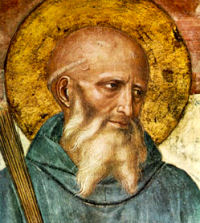
St. Benedict
 Born in Nursia, Italy, he was educated in Rome, was repelled by the vices of the city and in about 500 fled to Enfide, thirty miles away. He decided to live the life of a hermit and settled at mountainous Subiaco, where he lived in a cave for three years, fed by a monk named Romanus.
Despite Benedict's desire for solitude, his holiness and austerities became known and he was asked to be their abbot by a community of monks at Vicovaro. He accepted, but when the monks resisted his strict rule and tried to poison him, he returned to Subiaco and soon attracted great numbers of disciples. He organized them into twelve monasteries under individual priors he appointed, made manual work part of the program, and soon Subiaco became a center of spirituality and learning. He left suddenly, reportedly because of the efforts of a neighboring priest, Florentius, to undermine his work, and in about 525 settled at Monte Cassino.
He destroyed a pagan temple to Apollo on its crest, brought the people of the neighboring area back to Christianity, and in about 530 began to build the monastery that was to be the birthplace of Western monasticism. Soon disciples again flocked to him as his reputation for holiness, wisdom, and miracles spread far and wide. He organized the monks into a single monastic community and wrote his famous rule prescribing common sense, a life of moderate asceticism, prayer, study, and work, and community life under one superior. It stressed obedience, stability, zeal, and had the Divine Office as the center of monastic life; it was to affect spiritual and monastic life in the West for centuries to come.
While ruling his monks (most of whom, including Benedict, were not ordained), he counseled rulers and Popes, ministered to the poor and destitute about him, and tried to repair the ravages of the Lombard Totila's invasion. He died at Monte Cassino on March 21.
—Excerpted from the Dictionary of Saints, John J. Delaney
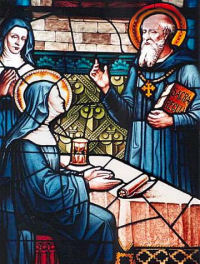 Born in Norcia about 480, Benedict's first studies were in Rome but, disappointed with city life, he retired to Subiaco, where he stayed for about three years in a cave—the famous sacro speco—dedicating himself wholly to God. In Subiaco, making use of the ruins of a cyclopean villa of the emperor Nero, he built some monasteries, together with his first disciples, giving life to a fraternal community founded on the primacy of the love of Christ, in which prayer and work were alternated harmoniously in praise of God.
Years later, he completed this project in Monte Cassino, and put it in writing in his Rule, the only work of his that has come down to us. Amid the ashes of the Roman Empire, Benedict, seeking first of all the kingdom of God, sowed, perhaps even without realizing it, the seed of a new civilization which would develop, integrating Christian values with classical heritage, on one hand, and the Germanic and Slav cultures on the other.
There is a particular aspect of his spirituality, which today I would particularly like to underline. Benedict did not found a monastic institution oriented primarily to the evangelization of barbarian peoples, as other great missionary monks of the time, but indicated to his followers that the fundamental, and even more, the sole objective of existence is the search for God: "Quaerere Deum."
He knew, however, that when the believer enters into a profound relationship with God he cannot be content with living in a mediocre way, with a minimalist ethic and superficial religiosity. In this light, one understands better the expression that Benedict took from St. Cyprian and that is summarized in his Rule (IV, 21)—the monks' program of life: Nihil amori Christi praeponere. Prefer nothing to the love of Christ.
Holiness consists in this valid proposal for every Christian that has become a true pastoral imperative in our time, in which one perceives the need to anchor life and history in solid spiritual references.
—Excerpted from Benedict XVI's Angelus address of July 10, 2005
Patronage: Against nettle rash; against poison; against witchcraft; agricultural workers; cavers; coppersmiths; dying people; erysipelas; Europe; farm workers; farmers; fever; gall stones; Heerdt, Germany; inflammatory diseases; Italian architects; kidney disease; monks; nettle rash; Norcia, Italy; people in religious orders; schoolchildren; servants who have broken their master's belongings; speliologists; spelunkers; temptations. See CatholicSaints.info for a complete listing.
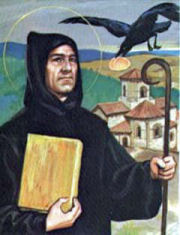
Symbols and Representation: Bell; broken cup; broken cup and serpent representing poison; broken utensil; bush; crosier; man in a Benedictine cowl holding Benedict's rule or a rod of discipline; raven.
Highlights Things to Do:
- Recommended Books:
- The Rule of Saint Benedict
- St. Benedict and St. Therese: The Little Rule & the Little Way by Fr Dwight Longenecker
- Listen My Son: St. Benedict for Fathers by Dwight Longenecker
- Citadel of God: A Novel About Saint Benedict by Louis de Wohl
- St. Benedict: Hero of the Hills for children by Mary Fabyan Windeatt (Vision Book series)
- The Holy Twins for children by Kathleen Norris and illustrated by Tomie dePaola
- Monasteries kept bees to provide honey for sweetening and mead made from fermented honey — wax was in great demand for candles. Honey and mead were used to make herbal remedies more palatable! Although it is not officially marked in the Roman Ritual,, there is a remote connection with St. Benedict and the Blessing of Bees. Read Address on Bees by Pius XII.
- After Benedict had been living as a hermit for several years a religious community came to him after the death of their abbot and asked Benedict to take over. Some of the monks didn't like this plan and the rigor of his rule and attempted to kill him with poisoned bread and wine. When St. Benedict made the sign of the Cross over the cup of wine and the bread, the cup holding the wine shattered (some versions say it spilled) and some versions indicate a raven carried off the bread. This website gives an explanation of the St. Benedict Medal and the meaning of the symbols on it which includes the poisoned cup and the raven.
For more information about the medal read The Medal of St. Benedict by Fr. Bernardine Patterson, OSB. and The Medal of St. Benedict and Prosper Gueranger, The Medal or Cross of St. Benedict: Its Origins, Meaning and Privileges.
- From Catholic Culture's Resources:
- Rule of St. Benedict
- Fulgens Radiatur (On St. Benedict) Pius XII
- The Holy Father's Message of July 7, 1999 sent to the Abbot of Subiaco for the celebration of the 1,500th anniversary of the foundation of St. Benedict's first monastery there.
- Listen to the Catholic Culture podcast Way of the Fathers: 52—Benedict of Nursia: The Elusive Man Behind the Rule by Mike Aquilina
- Learn more about St. Benedict:
- St. Benedict and his sister, St. Scholastica, are buried in Monte Cassino Abbey.
- See Catholic Cuisine for some feast day food ideas.
- See the statues of St. Benedict on St. Peter Basilica's Colonnade and Founder statue in St. Peter's Basilica.
St. Pius I
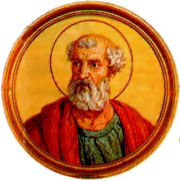 The Holy See remained vacant for three days, then Pius, an Italian from Aquileia, stepped into the shoes of the Fisherman. His father's name was Rufinus, and his brother Hermas was a former slave and the author of the early Christian document, The Shepherd, whose contents would seem to indicate that a monarchial episcopate was now recognized in Rome.
Pius was preoccupied with the challenge of the Gnostic leaders who by this time had been joined by Marcion of Pontus, and who continued to disseminate their system of belief widely. In July of 144, Pius presided over the assembly of presbyters that excommunicated Marcion from the orthodox community. But just as tormented as Pius was with the Gnostics, he was comforted in his friendship with Justin Martyr, that tremendous defender of Christ's doctrines, who now resided in Rome. A converted pagan, Justin sought the truth and through various schools of philosophy found it in Christianity.
An early source credits Pius with the decree that all heretics willing to repent should be received and baptized. Tradition holds that he died a martyr and was buried on Vatican Hill.
—Excerpted from The Popes: A Papal History, J.V. Bartlett
Highlights and Things to Do:
- Want your high schoolers to learn more about the Popes and the history of the Church? Reading The Story of the Church—Her Founding, Mission and Progress. A Textbook in Church History.
- Learn more about St. Pius I:
St. Olga
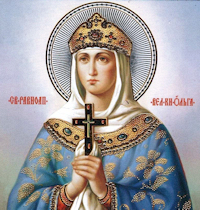 Saint Olga of Kiev was born 879 at Pskov, Russia into a family of Varyag origin according to tradition. Varyags were also known as Vikings or Norsemen, who came to the territory of current Russia, Ukraine and Belarus during the 8th and 9th centuries. This theory about Olga’s birth also explains the origin of her name, which is derived from the Scandinavian “Helga.” Other historical versions state that Olga was either a daughter of Oleg Veshchy, the founder of the state of Kievan Rus, or had Bulgarian roots.
Oleg Veshchy initiated Olga’s marriage with Prince Igor, who was the son of the Novgorod Prince Rurik, a founder of the Rurik Dynasty of Russian tsars. After the death of Oleg in 912, Igor became the ruler of Kievan Rus. In 945 Prince Igor went to the Slavic tribe of the Drevlyans to gather tributes. After he demanded a much higher payment, the Drevlyans killed him.
The death of the Kievan Prince raised a question about the next ruler of the country. Igor’s son, Svyatoslav, was only three years old, and hence Olga took the power into her hands. Interestingly, she had the full support the Rus army, which attests to the great respect she held among the people. After killing Igor, the Drevlyans sent their matchmakers to propose that Olga marry their Prince Mal. The Princess took revenge upon her husband’s death, killing all of the ambassadors. There are stories of her being quite the warrior queen.
She ruled Kievan Rus after Igor’s assassination in 945. Following her conversion and baptism in 957 in Constantinople, when she took the name Helena, she tried to introduce Christianity to the Ukraine on a wide scale, but failed. When her son Sviatoslav reached adulthood, she handed the throne to him, c.963. Apparently, she had a big influence on her grandson, Vladimir the Great, who in 988 made Christianity the official religion of Kievan Rus.
She is the grandmother of Saint Vladimir, great-grandmother of Saint Boris and Saint Gleb. Saint Olga died on 11 July 969 in Kiev of natural causes.
Patronage: converts; widows; Russia; archeparchy of Winnipeg, Manitoba
Highlights and Things to Do:
- Read Sts. Vladimir and Olga: Unlikely Converts and “Equal to the Apostles” in the National Catholic Register.
- Learn more about St. Olga Queen of Kiev: