September 2020 - Overview for the Month
 September
14
September
14 


The letters of the name "Maria" are evident in this ancient symbol. A crown was sometimes placed over the monogram by Medieval artists.


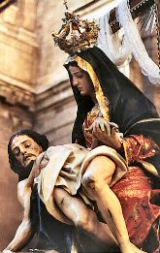
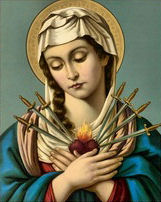
Pray for us.
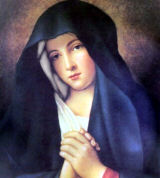
The month of September is dedicated to Our Lady of Sorrows, whose memorial the Church celebrates on September 15. September falls during the liturgical season known as Ordinary Time, which is represented by the liturgical color green. This symbol of hope is the color of the sprouting seed and arouses in the faithful the hope of reaping the eternal harvest of heaven, especially the hope of a glorious resurrection. It is used in the offices and Masses of Ordinary Time.
Respect for the Planet's Resources: We pray that the planet's resources will not be plundered, but shared in a just and respectful manner. (See also http://www.popesprayerusa.net/)
The feasts on the General Roman Calendar celebrated during the month of September are:
3. Gregory the Great, Memorial
6. TWENTY-THIRD SUNDAY IN ORDINARY TIME, Sunday
8. Nativity of the Blessed Virgin Mary, Feast
9. Peter Claver (USA), Memorial
12. Most Holy Name of Mary, Opt. Mem.
13. TWENTY-FOURTH SUNDAY IN ORDINARY TIME, Sunday
14. Exaltation of the Holy Cross, Feast
15. Our Lady of Sorrows, Memorial
16. Cornelius and Cyprian, Memorial
17. Robert Bellarmine, Hildegard of Bingen, Opt. Mem.
19. Januarius, Opt. Mem.
20. TWENTY-FIFTH SUNDAY IN ORDINARY TIME, Sunday
21. Matthew, Apostle; Ember Saturday, Feast
23. Pius of Pietrelcina, Memorial
26. Cosmas and Damian, Opt. Mem.
27. TWENTY-SIXTH SUNDAY IN ORDINARY TIME, Sunday
28. Wenceslaus; Lawrence Ruiz and Companions, Opt. Mem.
29. Michael, Gabriel & Raphael, Archangels, Feast
30. Jerome, Memorial
The Gospels for the Sundays in September 2020 are taken from St. Matthew and are from Year A, Cycle 2.
September
6th - 23rd Sunday in Ordinary Time |
If two agree on earth to ask anything it will be granted by my Father in heaven. |
September
13th - 24th Sunday in Ordinary Time |
Jesus tell Peter he must forgive his brother seventy times seven |
September
20th - 25th Sunday in Ordinary Time |
This Gospel relates the parable of the workers who came late to the vineyard but received the same pay. |
September
27th - 26th Sunday in Ordinary Time |
In this Gospel Jesus tells the parable of the two sons sent to the vineyard by their father. |
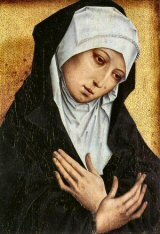 During
September, as in all of Ordinary Time (formerly known as Time
After Pentecost), the Liturgy does not focus on one particular
mystery of Christ, but views the mystery of Christ in all its aspects.
We follow the life of Christ through the Gospels, and focus on the
teachings and parables of Jesus and what it means for us to be a
follower of Christ. During Ordinary Time we can concentrate more
on the saints and imitate their holiness as Christ's followers.
During
September, as in all of Ordinary Time (formerly known as Time
After Pentecost), the Liturgy does not focus on one particular
mystery of Christ, but views the mystery of Christ in all its aspects.
We follow the life of Christ through the Gospels, and focus on the
teachings and parables of Jesus and what it means for us to be a
follower of Christ. During Ordinary Time we can concentrate more
on the saints and imitate their holiness as Christ's followers.
This month the main liturgical feasts are St. Gregory the Great (September 3), Birth of Mary (September 8), St. Peter Claver (September 9), Holy Name of Mary (September 12), Exaltation of the Holy Cross (September 14), Our Lady of Sorrows (September 15), Sts. Cornelius and Cyprian (September 16), St. Robert Bellarmine (September 17), St. Januarius (September 19), St. Matthew (September 21), Sts. Cosmas and Damian (September 26), St. Pio (September 23), Sts. Michael, Gabriel and Raphael (September 29) and St. Jerome (September 30).
The feasts of St. John Chrysostom (September 13), St. Andrew Kim and Companions (September 20) and St. Vincent de Paul (September 27) are superseded by the Sunday liturgy.
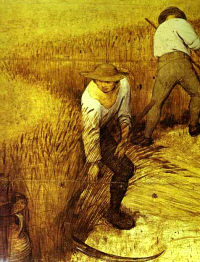 Since man is both a spiritual and physical being, the Church provides
for the needs of man in his everyday life. The Church's liturgy
and feasts in many areas reflect the four seasons of the year (spring,
summer, fall and winter). The months of August, September, October
and November are part of the harvest season, and as Christians we
recall God's constant protection over his people and give thanksgiving
for the year's harvest.
Since man is both a spiritual and physical being, the Church provides
for the needs of man in his everyday life. The Church's liturgy
and feasts in many areas reflect the four seasons of the year (spring,
summer, fall and winter). The months of August, September, October
and November are part of the harvest season, and as Christians we
recall God's constant protection over his people and give thanksgiving
for the year's harvest.
The September Ember Days were particularly focused on the end of the harvest season and thanksgiving to God for the season. Ember Days were three days (Wednesday, Friday and Saturday) set aside by the Church for prayer, fasting and almsgiving at the beginning of each of the four seasons of the year. The ember days fell after December 13, the feast of St. Lucy (winter), after the First Sunday of Lent (spring), after Pentecost Sunday (summer), and after September 14, the feast of the Exaltation of the Holy Cross (fall). These weeks were known as the quattor tempora, the "four seasons."
Since the late 5th century, the Ember Days were also the preferred dates for ordination of priests. So during these times the Church had a threefold focus: (1) sanctifying each new season by turning to God through prayer, fasting and almsgiving; (2) giving thanks to God for the various harvests of each season; and (3) praying for the newly ordained and for future vocations to the priesthood and religious life.
Since the reorganization of the Roman calendar in 1969 after the Second Vatican Council, Ember Days are still retained in principle, but how and when they are to be observed is at the discretion of each country's Episcopal Conference. There is no longer set Mass readings for the Ember Days in the Ordinary Rite.
Another harvest feast is September 29, the Feast of the Archangels Michael, Gabriel and Raphael. Before the revision of the calendar, this used to be only the feast of St. Michael. In many countries this day was referred to as "Michaelmas" and is celebrated with traditional foods and customs.
By Jennifer Gregory Miller, 2003.
Explanation of Ember Days—Three days set apart for fasting, abstinence, and prayer during each of the four seasons of the year. They were the Wednesday, Friday and Saturday after St. Lucy (or Lucia, d. 304) (December 13), the First Sunday of Lent, Pentecost, and the feast of the Holy Cross (September 14). Since the revision of the Roman calendar in 1969, Ember Days are to be observed at the discretion of the National Conference of Bishops. Moreover, their observance may be extended beyond three days and even repeated during the year. Possibly occasioned by the agricultural feasts of ancient Rome, they came to be observed by Christians for the sanctification of the different seasons of the year, and for obtaining God's blessing on the clergy to be ordained during the Embertides. (Etym. Anglo-Saxon oemerge, ashes.) — Modern Catholic Dictionary by John A. Hardon, SJ, Doubleday, 1980.