Lent: March 18th
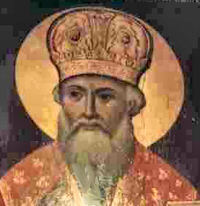
Optional Memorial of St. Cyril of Jerusalem, bishop, confessor and doctor
Other Commemorations: St. Alexander of Jerusalem, Bishop and Martyr (RM)

MASS READINGS
March 18, 2013 (Readings on USCCB website)
COLLECT PRAYER
O God, who through the Bishop Saint Cyril of Jerusalem led your Church in a wonderful way to a deeper sense of the mysteries of salvation, grant us, through his intercession, that we may so acknowledge your Son as to have life ever more abundantly. Through our Lord Jesus Christ, your Son, who lives and reigns with you in the unity of the Holy Spirit, God, for ever and ever.
Recipes (3)
Activities (4)
Prayers (14)
Library (4)
Blog & Podcasts (5)
» Enjoy our Liturgical Seasons series of e-books!
Cyril, bishop of Jerusalem, was banished from his see on three occasions. With St. Athanasius and others, he belongs to the great champions of faith in the fight against Arianism. Famous as a teacher and preacher, he has left a series of catechetical instructions that constitute a priceless heirloom from Christian antiquity. Of the twenty-four extant discourses, nineteen were directed to catechumens during Lent as a preparation for baptism, while five so-called mystagogical instructions were given during Easter time to make the mysteries of Christianity better known to those already baptized.
Historically today is the feast of Our Lady of Mercy. Today is an Ember Day in the Tridentine Rite. There are two principal objects for the Ember Days of this period of the year: the first is to offer to God the season of Spring, and, by fasting and prayer, to draw down His blessing upon it; the second is to ask Him to enrich with His choicest graces the priests and sacred ministers who are to receive their Ordination on Saturday.
St. Cyril of Jerusalem
Cyril of Jerusalem was given to the study of the Holy Scriptures from childhood, and made such progress that he became an eminent champion of the orthodox faith. He embraced the monastic institute and bound himself to perpetual chastity and austerity of life. He was ordained priest by St. Maximus, Patriarch of Jerusalem, and undertook the work of preaching to the faithful and instructing the catechumens, in which he won the praise of all. He was the author of those truly wonderful Catechetical Instructions, which embrace clearly and fully all the teaching of the Church, and contain an excellent defense of each of the dogmas of religion against the enemies of the faith. His treatment of these subjects is so distinct and clear that he refuted not only the heresies of his own time, but also, by a kind of foreknowledge, as it were, those which were to arise later. Thus he maintains the Real Presence of the Body and Blood of Christ in the adorable sacrament of the Altar. On the death of Patriarch St. Maximus, the bishops of the province chose Cyril in his place.
As Bishop he endured, like blessed Athanasius, his contemporary, many wrongs and sufferings for the sake of the faith at the hands of the Arians. They could not bear his strenuous opposition to their heresy, and thus assailed him with calumnies, deposed him in a pseudo-council and drove him from his see. To escape their rage, he fled to Tarsus in Cilicia and, as long as Constantius lived, he bore the hardships of exile. On the death of Constantius and the accession of Julian the Apostate, Cyril was able to return to Jerusalem, where he set himself with burning zeal to deliver his flock from false doctrine and from sin. He was driven into exile a second time, under the Emperor Valens, but when peace was restored to the Church by Theodosius the Great, and the cruelty and insolence of the Arians were restrained, he was received with honor by the Emperor as a valiant soldier of Christ and restored to his see. With what earnestness and holiness he fulfilled the duties of his exalted office was proved by the flourishing state of the Church at Jerusalem, as described by St. Basil, who spent some time there on a pilgrimage to the holy places.
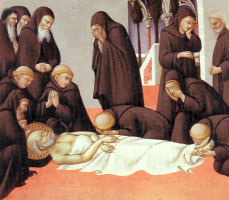 Tradition states that God rendered the holiness of this venerable Patriarch illustrious by signs from heaven, among which is numbered the apparition of a cross, brighter than the sun, which was seen at the beginning of his Patriarchate. Not only Cyril himself, but pagans and Christians alike were witnesses of this marvel, which Cyril, after having given thanks to God in church, announced by letter to Constantius. A thing no less wonderful came to pass when the Jews were commanded by the impious Emperor Julian to restore the Temple which had been destroyed by Titus. An earthquake arose and great balls of fire broke out of the earth and consumed the work, so that Julian and the Jews were struck with terror and gave up their plan. This had been clearly foretold by Cyril. A little while before his death, he was present at the Ecumenical Council at Constantinople, where the heresies of Macedonius and Arius were condemned. After his return to Jerusalem, he died a holy death at sixty-nine years of age in the thirty-fifth year of his bishopric. Pope Leo XIII ordered that his office and mass should be said throughout the Universal Church.
Highlights and Things to Do:
- Read more about St. Cyril of Jerusalem:
- Read Pope Benedict XVI's catechesis on St. Cyril of Jerusalem.
- See Catholic Culture's Fathers of the Church resource, which includes 23 of St. Cyril's Catechetical Lectures and his Procatechesis.
- See Catholic Culture's Way of the Fathers Cyril of Jerusalem, Mystery and Mayhem by Mike Aquilina.
- CatholicSaints.info has multiple resources for further reading and listening to this Doctor of the Church.
- Read part of St. Cyril's Catechetical Lectures On the Passion of Our Lord Jesus Christ, which is very fitting meditation material for Lent, and the two other audiobooks read by James Majewski.
- Watch this video on St. Cyril of Jerusalem from the Apostleship of Prayer.
- Read The Arian Heresy (Chapter Three of Hilaire Belloc's The Great Heresies).
St. Alexander of Jerusalem
 Alexander was a student with Origen at the famous Christian school of Alexandria in the late second century. He became bishop of Cappadocia and during the persecution of Severus was imprisoned for several years (204-211).
Following his release from prison, he made a pilgrimage to Jerusalem and was proclaimed Coadjutor Bishop there in the year 212. Demetrius, the Bishop of Alexandria, censured Alexander for participating in the ordination of Origen and for encouraging Origen to teach in churches while still a layman.
Despite this, Alexander received Origen in exile. Meanwhile, in Jerusalem, Alexander developed a great theological library. During the persecution of Decius, he was seized and again imprisoned.
After making a public confession of faith, he was condemned and thrown to the wild beasts, but they refused to attack him. Alexander was then taken to Caesarea where he died in chains in the year 251.
The Church recognizes him as a martyr. St. Alexander, despite his great learning and important ecclesiastical positions, was known as an individual of great mildness, especially in his sermons.
When put to the test during two persecutions, he remained steadfast in faith and was willing to suffer death for the Faith.
Highlights and Things to Do:
- Read more about St. Alexander of Jerusalem:
- Read Book VI of Eusebius' Church History on Catholic Culture in the Fathers of the Church section. This chapter has numerous references to St. Alexander and about the persecution under Decius. There are lessons to be learned from history and our present age is also an age of martyrs.
- See also Holy Hieromartyr Alexander.
Monday of the Fifth Week of Lent
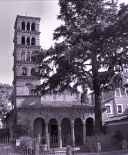
Station with San Crisogono in Trastevere (St. Chrysogonus in Trastevere):
The Station, at Rome, is in the church of St. Chrysogonus, one of the most celebrated martyrs of the Church of Rome. His name is inserted in the Canon of the Mass. The church was probably built in the 4th century under Pope Sylvester I and one of the tituli, the first parish churches of Rome, known as the Titulus Chrysogoni.
For more on San Crisogono in Trastevere, see:
For further information on the Station Churches, see The Stational Church.