Ordinary Time: November 24th
Memorial of St. Andrew Dung-Lac, priest and martyr, and companions, martyrs
Other Commemorations: St. Chrysogonus, Martyr (RM); Sts. Flora and Mary, Virgins and Martyrs (RM)

MASS READINGS
November 24, 2009 (Readings on USCCB website)
COLLECT PRAYER
O God, the source and origin of all fatherhood, you kept the blessed martyrs Andrew and his companions faithful to the cross of your Son even to the shedding of their blood. Through their intercession enable us to spread your love among our brothers and sisters, that we may be called and may truly be your children. We ask this through our Lord Jesus Christ, your Son, who lives and reigns with you and the Holy Spirit, God, for ever and ever. Amen.
Recipes (1)
Activities (12)
Prayers (7)
Library (1)
Blog & Podcasts (0)
» Enjoy our Liturgical Seasons series of e-books!
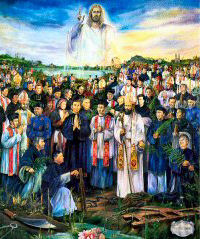
Today the Church celebrates the memorial of St. Andrew Dung-Lac, priest and martyr, and companions, martyrs. St. Andrew was one of 117 people who were martyred in Vietnam between 1820 and 1862. The last of the martyrs were 17 laypersons, one of them a 9-year-old, executed in 1862.
According to the 1962 Missal of Bl. John XXIII the Extraordinary Form of the Roman Rite, today is the feast of St. John of the Cross which is now celebrated on December 14. It is also the commemoration of St. Chrysogonus, a martyr of Aquilea at the beginning of the fourth century. His name occurs in the Canon of the Mass.
St. Andrew Dung-Lac and Companions
 There are 117 martyrs in this group and although they died at different times, they were all canonized by Pope John Paul II on June 19, 1988. Of the group, 96 were Vietnamese, 11 were Spaniards, and 10 were French. There were 8 bishops, 50 priests and 59 lay Catholics in the group. Of the priests, 11 were Dominicans, 10 belonged to the Paris Mission Society, and the rest were diocesan priests plus one seminarian. Certain individual martyrs were mentioned by name in the process of canonization: Andrew Dung-Lac, a diocesan priest; Thomas Tran-Van-Thien, a seminarian; Emmanuel Le-Van-Pung, father of a family; the Dominican bishops Jerome Hermosilla and Valentine Berrio-Ochoa; and John Theophane Venard.
—Excerpted from Saints of the Roman Calendar by Enzo Lodi
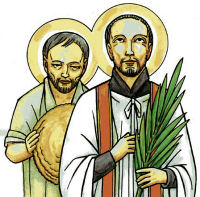
St. Andrew Dung-Lac's name was originally Dung An Trân, and he was born about 1795 in a poor and pagan family in Bac-Ninh in North Vietnam. When he was twelve the family had to move to Hà-Nôi (Hanoi) where his parents could find work. There he met a catechist and got food and shelter from him. He also got education in the Christian faith for three years, and was baptized in Vinh-Tri with the Christian name Andrew (Andrew Dung). After learning Chinese and Latin he became a catechist, and thereafter taught catechism in the country. He was chosen to study theology, and on March 15, 1823 he was ordained a priest. As parish priest in Ke-Dâm he was tireless in his preaching. He often fasted and lived a simple and moral life, he was a good example for the people, and many were baptized. In 1835 he was imprisoned under emperor Minh-Mang's persecutions (he was called Vietnam's emperor Nero), but his freedom was purchased by donations from members of the congregation he served. To avoid persecutions he changed his name to Lac (Andrew Lac) and moved to another prefecture to continue his work. But on November 10, 1839 he was again arrested, this time with Peter Thi, another Vietnamese priest whom he was visiting so that he might go to confession.
Once again Andrew was liberated, along with Peter Thi, in exchange for money. Their freedom was brief. They were soon re-arrested and taken to Hanoi, where both suffered dreadful torture. Finally they both were beheaded December 21, 1839.
Highlights and Things to Do:
- Find out more about the Vietnam martyrs:
- Find out more about the suffering of the Church in communist Vietnam.
- Pray a rosary for those suffering persecution today in Vietnam.
- Cook a Vietnamese dish in honor of today's saints. See Catholic Cuisine for some spring rolls.
St. Chrysogonus
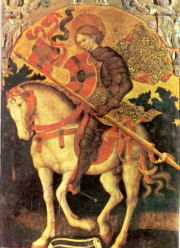 St. Chrysogonus probably was a native of Aquileia, although he was venerated in Rome already in the fourth century. According to legend he was brought to Rome under Emperor Diocletian and thrown into prison; there he stayed two years, sustained by St. Anastasia. That pious woman was obliged to endure many hardships from her husband Publius because of the Christian faith, but she derived much comfort from these short visits and acts of mercy. When all imprisoned Christians were ordered to be executed, Chrysogonus was brought to Aquileia. There Diocletian addressed him, "I have called you before me, Chrysogonus, to load you with honors provided you are willing to adore the gods." The saint replied, "Only the true God will I adore. Idols which neither have existence nor life and only represent devils, I hate and curse." Embittered by such an answer, the Emperor commanded him to be beheaded on November 24. His body was submerged in the sea; when found shortly after on the shore, it was interred by the priest Zoilus in his house (c. 304). Great honor was paid Chrysogonus by the Church of Rome; his name was inserted in the Canon, and a station church in his honor was erected.
—Excerpted from The Church's Year of Grace, Pius Parsch
Symbols and Representation: Roman patrician's robes; sword; millstone
Highlights and Things to Do:
- Read more about St. Chrysogonus:
- Christian Iconography has some images of St. Chrysogonus.
- St. Chrysogonus was beheaded on November 23, 304 at Aquileia, Italy. His corpse was thrown into the sea, washed ashore, and was buried by the aged priest, Zoilus, at Venice, Italy. His head is in the Roman Church of Saint Chrysogonus (San Crisogono). See Wikipedia and Roman Churches for more information about the Roman church.
Sts. Flora and Mary of Cordoba
 In the reign of Abderramene II, king of the Saracens at Cordova in Spain, Flora, because she was of Muslim extraction by her father, but had been secretly instructed in the faith by her mother, was impeached by her own brother before the cadi, or judge of the city. This magistrate caused her to be scourged, and beaten on the head till in some parts her scull was bare. Then he put her into the hands of her brother, that he might overcome her resolution.
After some time she made her escape over a high wall, and took shelter with a sister at Ossaria. Having lain concealed some time, she ventured back to Cordova, and prayed publicly in the church of St. Aciclus, the martyr. There she met with Mary, sister to the deacon Valabonsus, who had lately received the crown of martyrdom. The zealous virgins agreed to present themselves in the court of the cadi, by whose order they were apprehended, and confined to a close dungeon, where no one had access to them but certain impious lewd women.
St. Eulogius, who was at that time detained in another prison, wrote and sent to them his Exhortation to Martyrdom. After a third examination, the cadi commanded them both to be beheaded. The sentence was executed on the same day, the 24th of November, in 851. They are named in the Roman Martyrology.
Patronage: abandoned people; betrayal victims; converts; martyrs; single laywomen
Highlights and Things to Do:
- See more about Sts. Flora and Mary: