|
The month of October is dedicated to the Holy Rosary. The Memorial of Our Lady of the Rosary is celebrated on October 7. October falls during the liturgical season known as Ordinary Time, which is represented by the liturgical color green.
General: That the Synod of Bishops may help bishops and theologians as well as catechists and pastoral workers engaged in the service of the Word of God transmit with courage the truth of the faith in communion with the entire Church.
Missionary: That in this month dedicated to the missions, through the promotional activities of the Pontifical Missionary Works and other organisms, the Christian may feel the need to participate in the Church’s universal mission with prayer, sacrifice and concrete help.
The feasts on the General Roman Calendar celebrated
during the month of October are:
All the Gospels for the Sundays in October 2008 are taken from Year A, Cycle 2, the Gospel of St. Matthew.
This month the main liturgical feasts are St. Thérèse (October 1), Guardian Angels (October 2), St. Francis of Assisi (October 4), Our Lady of the Rosary (October 7), St. Teresa of Jesus (October 15), St. Hedwig and St. Margaret Mary, (October 16), St. Ignatius of Antioch (October 17), St. Luke (October 18), and St. Anthony Mary Claret (October 24) and Sts. Simon and Jude (October 28). The feast of St. Isaac Jogues, St. John de Brébeuf and Companions (October 19) is superceded by the Sunday liturgy.
The feasts in October also include two of the most popular, time-honored devotions of Catholics, the devotion to the Holy Rosary (October 7) and the Guardian Angels (October 2). In October 2002 our Holy Father John Paul II wrote the Apostolic Letter Rosarium Virginis Mariae (the Rosary of the Virgin Mary)." This letter introduced five new mysteries, called the Luminous or Mysteries of Light, which are (1) Jesus' Baptism in the Jordan, (2) Jesus' self-manifestation at the wedding of Cana, (3) Proclamation of the Kingdom of God, with the call to conversion, (4) the Transfiguration, and (5) the Institution of the Eucharist. Try to make a more concerted effort to pray the Rosary together as a family during the month of October, read the Apostolic Letter to understand the beauty of this devotion more deeply, and pray the new Luminous mysteries. October 16 is known as "Pope Day" on which we celebrate the gift of the papacy and our current pope. Every person has a guardian angel assigned to them, and October 2 the Church celebrates the role of these Guardian Angels. We should show devout gratitude to God for placing these angels at our service. Having a guardian should give us confidence during all of life's difficulties. Every Catholic should know the Angele Dei (Angel of God) prayer and pray it often. The Directory on Popular Piety suggests that families pray it at morning and evening prayers or after the Angelus.
All Hallows' Eve or
Halloween heralds the month of November with emphasis on the
Communion of Saints, especially the Church Suffering (the Poor
Souls in Purgatory) and the second coming of Christ or parousia.
This last day of October on the secular calendar is second only
to Christmas in commercial preparations. The secular festivities
center on ghouls, witches and devils, but the Christian counterpart
focus on the communion of saints. As Christians living a "Catholic
Culture", we should try to explore the Christian roots of the
Halloween festivities.
|
Let us
imitate what they contain so as to obtain what they promise.
Highlights
October
18
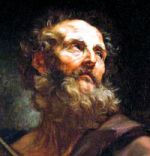
St. Luke St.
Luke was a physician from Antioch and a disciple of St. Paul. He
is the author of the third Gospel and of the Acts of the Apostles.
In his Gospel he highlights the universality of salvation.Paella is a delicious,
typical Spanish dish which has literally hundreds of ways to be prepared.
Try making a version of this recipe in honor of the Spanish saint
Teresa of Avila, whose feast is October 15.
As a child, St. Thérèse the Little Flower had
“sacrifice beads,” which were a small string of beads to help her
count the “presents” she offered to God. Each time she would make
a sacrifice such as letting someone else have their way, St. Therese
would secretly reach into her pocket and “pull a bead” to Jesus on
the Crucifix. Find out more about the sacrifice beads and implement
the practice in the family.
Symbols
The sailing vessel here represents the Church,
which St. Jude (also known as Thaddeus or Lebbaeus) carried to many
ports as he journeyed as a missionary.
The companion of St. Jude on many missionary
journeys, St. Simon was known as a great fisher of men through the
power of the Gospel.
St. Francis, the father of the Franciscan
Order, for two years before his death bore the marks of the Lord's
Passion upon his hands, feet and side. The tears on the cross
represent the marks of the stigmata.
A convert of St. John, reputedly consecrated
Bishop of Antioch by St. Peter, St. Ignatius was an important link
between the first and second centuries of the Church. He was the
writer of seven epistles as he proceeded to his martyrdom when condemned
by Trajan.
A Carmelite nun who left her cloister at Avila
and set up a reformed Carmelite Order in Spain and Portugal. She
endured much suffering with a joyful heart.
|


During
October, as in all of Ordinary Time (formerly known as Time After
Pentecost), the Liturgy does not focus on one particular mystery
of Christ, but views the mystery of Christ in all its aspects. We
follow the life of Christ through the Gospels, and focus on the
teachings and parables of Jesus and what it means for each of us to be a
follower of Christ. During Ordinary Time we can concentrate more
on the saints and imitate their holiness as Christ's followers.
October usually is an enjoyable time of the year in the United States. The
autumn season manifests itself with wonderful fall foliage in many
parts of the country. The temperatures are cooler, inviting people
outdoors for nature walks, apple or pumpkin picking. School routines
are more established and football season is in full swing. The celebrations
of the Church for the month of October are also wonderful and unique.
The feasts of some of the most popular saints of the universal Church
are celebrated during this month: St. Therese the Little Flower
(France), St. Francis of Assisi (Italy) and St. Teresa of Avila
(Spain). These saints come from different countries, and in honoring
these saints we can include cultural dishes or activities from each
country to make the feastday even more special. Read more about
the lives of these saints. Perhaps the family can pick one virtue
that each saint practiced well and try to implement it.
All Hallows' Eve or
Halloween heralds the month of November with emphasis on the
Communion of Saints, especially the Church Suffering (the Poor
Souls in Purgatory) and the second coming of Christ or parousia.
This last day of October on the secular calendar is second only
to Christmas in commercial preparations. The secular festivities
center on ghouls, witches and devils, but the Christian counterpart
focus on the communion of saints. As Christians living a "Catholic
Culture", we should try to explore the Christian roots of the
St.
Luke was a physician from Antioch and a disciple of St. Paul. He
is the author of the third Gospel and of the Acts of the Apostles.
In his Gospel he highlights the universality of salvation.