Collect: Father, in glorifying Christ and sending us your Spirit, you open the way to eternal life. May our sharing in this gift increase our love and make our faith grow stronger. Grant this through our Lord Jesus Christ, your Son, who lives and reigns with you and the Holy Spirit, one God, for ever and ever. Amen.
Friday of the Seventh Week of Easter
Old Calendar: St. Gregory Nazianzen; bishop, confessor and doctor
- RECIPES
- None
- ACTIVITIES
- PRAYERS
- LIBRARY
- None
Item Tools
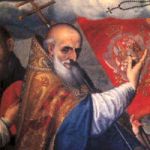
According to the 1962 Missal of Bl. John XXIII the Extraordinary Form of the Roman Rite, today is the feast of St. Gregory Nazianzen. He was educated at Athens in all the sciences with St. Basil the Great. He became bishop of Nazianzen and his profound knowledge earned for him the title of Doctor and Theologian, titles confirmed by the Church. He died in 389. His feast in the Ordinary Form of the Roman Rite is celebrated January 2.
St. Gregory Nazianzen
Gregory, surnamed the "Theologian" by the Greeks, was born at Nazianz in Cappadocia in 329. He was one of the "Three Lights of the Church from Cappadocia." To his mother, St. Nonna, is due the foundation for his saintly life as an adult. He was educated at the most famous schools of his time — Caesarea, Alexandria, Athens. At Athens he formed that storied bond of friendship with St. Basil which was still flaming with all the fervor of youthful enthusiasm when he delivered the funeral oration at the grave of his friend in 381. Gregory was baptized in 360, and for a while lived the quiet life of a hermit. In 372 he was consecrated bishop by St. Basil. In 381 he accepted the see of Constantinople, but grieved by the constant controversies retired again to the quiet life he cherished so highly and dedicated himself entirely to contemplation. During his life span the pendulum was continually swinging back and forth between contemplation and the active ministry. He longed for solitude, but the exigencies of the times called him repeatedly to do pastoral work and to participate in the ecclesiastical movements of the day. He was unquestionably one of the greatest orators of Christian antiquity; his many and great accomplishments were due in great measure to his exceptional eloquence. His writings have merited for him the title of "Doctor of the Church." Excerpted from The Church's Year of Grace, Pius Parsch. Things to Do:- We too must harmoniously combine the two phases of spiritual life, the contemplative which tends to solitude and the active or pastoral which responds to the need of the times and the good of souls.