March 2021 - Overview for the Month

St. Patrick
 St.
Patrick is called the "Apostle of Ireland." He established
the Catholic Church throughout Ireland on lasting foundations. He
traveled all over the country preaching, teaching, building churches,
opening schools and monasteries, converting chiefs and bards, and
everywhere supporting his preaching with miracles.
St.
Patrick is called the "Apostle of Ireland." He established
the Catholic Church throughout Ireland on lasting foundations. He
traveled all over the country preaching, teaching, building churches,
opening schools and monasteries, converting chiefs and bards, and
everywhere supporting his preaching with miracles.



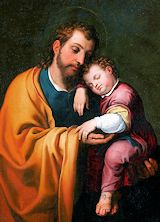
The month of March is dedicated to St. Joseph.The entire month falls during the liturgical season of Lent which is represented by the liturgical color purple — a symbol of penance, mortification and the sorrow of a contrite heart.
Sacrament of Reconciliation: Let us pray that we may experience the sacrament of reconciliation with renewed depth, to taste the infinite mercy of God. (See also Apostleship of Prayer)
The feasts on the General Roman Calendar celebrated during the month of March are:
7. THIRD SUNDAY OF LENT, Sunday
8. John of God, Opt. Mem.
9. Frances of Rome, Opt. Mem.
14. FOURTH SUNDAY OF LENT, Sunday
17. Patrick, Opt. Mem.
18. Cyril of Jerusalem, Opt. Mem.
19. JOSEPH, SPOUSE OF MARY, Solemnity
21. FIFTH SUNDAY OF LENT, Sunday
23. Turibius of Mogrovejo, Opt. Mem.
25. ANNUNCIATION OF THE LORD, Solemnity
28. PALM SUNDAY OF THE LORD'S PASSION, Sunday
The Gospel readings for March are taken from St. John and St. Mark. All are from Year B, Cycle 1.
March 7th - 3rd Sunday of Lent |
The Gospel is about Christ driving the money changers from the temple. |
March 14th - 4th Sunday of Lent |
The Gospel tells about Nicodemus nocturnal visit to Our Lord. |
March 21st - 5th Sunday of Lent |
This Gospel tells the story of Jesus bringing Lazarus back to life. |
March 28th - Palm Sunday of Lent |
The reading of the Passion. |
 As we continue our journey "up to Jerusalem" during the
month of March, three prominent ideas are proposed for our contemplation
by the liturgy of Lent: the Passion and Resurrection of Christ,
baptism, and penance.
As we continue our journey "up to Jerusalem" during the
month of March, three prominent ideas are proposed for our contemplation
by the liturgy of Lent: the Passion and Resurrection of Christ,
baptism, and penance.
The Solemnity of St. Joseph is a special landmark this month in which we will celebrate the great honor bestowed upon the foster father of Jesus. And if you are Irish (who isn't), St. Patrick's feast is another cause for a joyful celebration. The feast of the Annunciation is celebrated on March 25.
The saints that we will focus on this month and try to imitate are St. Katharine Drexel (March 3), St. Casimir (March 4), Sts. Perpetua and Felicity (March 7), St. John of God (March 8), St. Frances of Rome (March 9), St. Patrick (March 17), St. Cyril of Jerusalem (March 18), St. Joseph (March 19) and St. Toribio de Mogrovejo (March 23).
 Here
and there in the stark March landscape, a few plants and trees are
beginning to give evidence of the new life that winter’s frost
and chill had concealed from our eyes. The Church’s vibrant
new life has been obscured, too, by the austerity of the penitential
season of Lent. But that life is indisputable, and it will burgeon
forth on Easter as Christ coming forth from his tomb!
Here
and there in the stark March landscape, a few plants and trees are
beginning to give evidence of the new life that winter’s frost
and chill had concealed from our eyes. The Church’s vibrant
new life has been obscured, too, by the austerity of the penitential
season of Lent. But that life is indisputable, and it will burgeon
forth on Easter as Christ coming forth from his tomb!
During this month we will continue our journey to the cross with our acts of penitence. We will reflect on our mortality ("Remember man thou art dust") and the shortness of life ("and to dust thou shall return"). We will heed the call, "Now is the acceptable time, now is “the day of salvation (2 Corinthians 6:2).” Just like Our Lord's earthly life every moment of our lives is leading up to the last moment—when for eternity we will either go to God or suffer the fires of hell. During this month we will go from the suffering of Good Friday to the joy of Easter Sunday. We will trade the purple of penance for the white of victory and resurrection. The feast of the Annunciation, normally celebrated on March 25, has been transferred to April 4 since it falls on Good Friday.
Let us not tire of doing our good works and penance, but continue with the enthusiasm of the catechumens on their way to Easter and Baptism. May our Lenten observance be a joyful journey — and not a forced march.
As the weeks of Lent progress let us not tire of doing our good works and penance, but continue with the enthusiasm of the catechumens on their way to Easter and Baptism. May our Lenten observance be a joyful journey — and not a forced march.
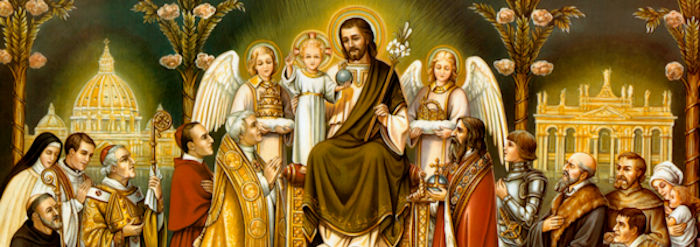
�This patronage must be invoked as ever necessary for the Church, not only as a defense against all dangers, but also, and indeed primarily, as an impetus for her renewed commitment to evangelization in the world and to re-evangelization,� wrote St. John Paul II in Redemptoris Custos (Guardian of the Redeemer).
John Paul II further said, �Because St. Joseph is the protector of the Church, he is the guardian of the Eucharist and the Christian family. Therefore, we must turn to St. Joseph today to ward off attacks upon the real presence of Christ in the Eucharist and upon the family. We must plead with St. Joseph to guard the Eucharistic Lord and the Christian family during this time of peril.�