February 2021 - Overview for the Month
Presentation of the Lord
 This
feast is a festival of light. The procession, in which the blessed
candles are carried by clergy and faithful, recalls by its symbolism
the manifestation of Christ, the Light of the world, received in
the temple. "A light to the revelation of the Gentiles, and the
glory of Thy people Israel."
This
feast is a festival of light. The procession, in which the blessed
candles are carried by clergy and faithful, recalls by its symbolism
the manifestation of Christ, the Light of the world, received in
the temple. "A light to the revelation of the Gentiles, and the
glory of Thy people Israel."
Candlemas Ceremony
 The family, who with lighted candles goes in
spirit to the Temple with our Lady, will learn a wonderful lesson
of her humility.
The family, who with lighted candles goes in
spirit to the Temple with our Lady, will learn a wonderful lesson
of her humility. 



The month of February is dedicated to the Holy Family. This year the first 16 days of February fall during the liturgical season known as Ordinary Time which is represented by the liturgical color green. Green, the symbol of hope, is the color of the sprouting seed and arouses in the faithful the hope of reaping the eternal harvest of heaven, especially the hope of a glorious resurrection. The remaining days of February are the beginning of Lent. The liturgical color changes to purple — a symbol of penance, mortification and the sorrow of a contrite heart.
Violence Against Women: We pray for women who are victims of violence, that they may be protected by society and have their sufferings considered and heeded. (See also Apostleship of Prayer)
The feasts on the General Roman Calendar celebrated during the month of February are:
2. Presentation of the Lord, Feast
3. Blaise; Ansgar, Opt. Mem.
5. Agatha, Memorial
6. Paul Miki and Companions, Memorial
7. FIFTH SUNDAY IN ORDINARY TIME, Sunday
8. Jerome Emiliani; Josephine Bakhita, Opt. Mem.
10. Scholastica, Memorial
11. Our Lady of Lourdes, Opt. Mem.
14. SIXTH SUNDAY IN ORDINARY TIME, Sunday
21. FIRST SUNDAY OF LENT, Sunday
22. Chair of St. Peter, Feast
23. Polycarp of Smyrna; Ember Friday, Opt. Mem.
27. Gregory Narek, Opt. Mem.
28. SECOND SUNDAY OF LENT, Sunday
The Gospel readings for the Sundays in February are taken from St. Mark and are from Year B, Cycle 1 of the readings.
February 7th - Fifth Sunday of Ordinary Time |
The Gospel recounts Christ's cure of St. Peter's mother-in-law. |
February
14th - Sixth Sunday of Ordinary Time |
The Gospel is about Christ healing a leper. |
February
21st - First Sunday of Lent |
Jesus is tempted by the devil in the desert. |
February 28th - Second Sunday of Lent |
The Gospel relates the story of the Transfiguration of our Lord on Mt. Tabor.> |
 The
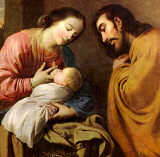
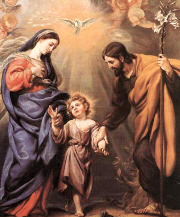
month of February is traditionally dedicated to the Holy Family.
Between the events which marked Christmas and the beginning of Christ's
public life the Church has seen fit to recall the example of the
Holy Family for the emulation of the Christian family.
The
month of February is traditionally dedicated to the Holy Family.
Between the events which marked Christmas and the beginning of Christ's
public life the Church has seen fit to recall the example of the
Holy Family for the emulation of the Christian family.
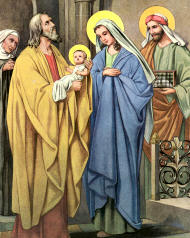
The Feast of the Presentation (February 2) or Candlemas forms a fitting transition from Christmas to Easter. The small Christ-Child is still in His Mother's arms, but already she is offering Him in sacrifice.
The saints that we will focus on this month and try to imitate are St. Blaise (February 3), St. Agatha (February 5), St. Paul Miki & Companions (February 6), St. Jerome Emiliani and St. Josephine Bakhita (February 8), St. Scholastica (February 10), Our Lady of Lourdes (February 11), the Chair of St. Peter (February 22) and St. Polycarp (February 23).
The feasts of Sts. Cyril and Methodius (February 14) and St. Peter Damian (February 21), is superseded by the Sunday Liturgy. The feast of the Seven Founders of the Orders of Servites (February 17) is superseded by the Ash Wednesday Liturgy.
 Though
the shortest month of the year, February is rich in Liturgical activity. It contains a feast (Presentation of our Lord)
that bridges two other seasons (Christmas and Easter)! In addition,
the faithful may receive in February
two of the four major public
sacramentals that the Church confers during the liturgical year:
blessed candles and the blessing of throats.
Though
the shortest month of the year, February is rich in Liturgical activity. It contains a feast (Presentation of our Lord)
that bridges two other seasons (Christmas and Easter)! In addition,
the faithful may receive in February
two of the four major public
sacramentals that the Church confers during the liturgical year:
blessed candles and the blessing of throats.
The Solemnity of the Presentation of the Lord on February 2nd harkens back to the Christmas mystery of Light except that now, Christ, the helpless babe, is “the Light of Revelation to the Gentiles who will save his people from their sins.” Candles, symbolizing Christ our Light, will be carried in procession this day, as will be the Paschal candle during the Easter Vigil Liturgy.
"The Light of Revelation" shines more brightly with each successive Sunday of Ordinary Time, until its magnificence – exposing our sinfulness and need for conversion – propels us into the penitential Season of Lent. We prepare to accept the cross of blessed ashes on Ash Wednesday (March 1) and plunge ourselves into anticipating the major exercises of Lent – fasting, prayer, almsgiving – laying our thoughts and prayers on the heart of our Mother Mary. She, who offered her Son in the temple and on the Cross, will teach us how to deny ourselves, take up our cross daily, and follow after her Son.
 Ideally,
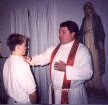
the members of the domestic church should try to have the candles
for their home altar blessed on Candlemas Day (February 2nd);
and the next morning, on the Feast of St. Blaise, all might
receive the blessing of the throats. Always a solicitous Mother,
the Church offers this sacramental during the wintry month
of February, and also sets aside the World Day of Prayer for
the Sick on February 11, the feast of Our Lady of Lourdes.
Ideally,
the members of the domestic church should try to have the candles
for their home altar blessed on Candlemas Day (February 2nd);
and the next morning, on the Feast of St. Blaise, all might
receive the blessing of the throats. Always a solicitous Mother,
the Church offers this sacramental during the wintry month
of February, and also sets aside the World Day of Prayer for
the Sick on February 11, the feast of Our Lady of Lourdes.