Lent: February 19th
Tuesday of the First Week of Lent
Other Commemorations: Bl. Conrad of Piacenza Confalonieri, Hermit and Franciscan Tertiary (RM), St. Barbatus, Bishop (RM)
Free eBook:
|
| Free eBook: Pope Francis on the Family |
MASS READINGS
February 19, 2013 (Readings on USCCB website)
COLLECT PRAYER
Look upon your family, Lord, that, through the chastening effects of bodily discipline, our minds may be radiant in your presence with the strength of our yearning for you. Through our Lord Jesus Christ, your Son, who lives and reigns with you in the unity of the Holy Spirit, God, for ever and ever.
Recipes (3)
Activities (10)
Prayers (5)
Library (0)
Blog & Podcasts (0)
» Enjoy our Liturgical Seasons series of e-books!
Historically today is the feast of St. Conrad of Piacenza, a friar and hermit celebrated for piety and miraculous cures at Noto in Sicily and St. Gabinus, brother of Pope St. Caius, father of St. Susanna, who was ordained in his old age.
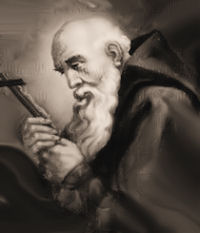
Bl. Conrad of Piacenza
Blessed Conrad was a Franciscan tertiary and hermit. He was a noble, born at Piacenza, Italy. While hunting, Conrad made a fire that quickly engulfed a neighboring cornfield. A poor man was arrested as an arsonist and condemned to death, but Conrad stepped forward to admit his guilt in the matter. As a result, he had to sell his possessions to pay for the damages. Conrad and his wife decided to enter the religious life. She became a Poor Clare, and he entered the Franciscan Third Order as a hermit. Conrad went to Noto, on Sicily, where he lived the next three decades at St. Martin's Hospital and in a hermitage built by a wealthy friend. During his last years, he lived and prayed in the grotto of Pizzone outside of Noto.
—Excerpted from Our Sunday Visitor's Encyclopedia of Saints
Patronage: against hernias; hunters; Cacciatori, Italy; Calendasco, Italy; city of Noto, Sicily; diocese of Noto, Sicily
Symbols and Representation: Franciscan hermit with a cross upon which birds perch; bearded, old man with a tau staff, bare feet, Franciscan cincture, and small birds fluttering around him; old man with stags and other animals around him
Highlights and Things to Do:
- Read more about Blessed Conrad of Piacenza:
- St. Conrad's relics are held in the Cathedral of St. Nicholas in Noto, Italy, also called "Noto Cathedral."
St. Barbatus
St. Barbatus was born in the territory of Benevento in Italy, toward the end of the pontificate of St. Gregory the Great, in the beginning of the seventh century. His parents gave him a Christian education, and Barbatus in his youth laid the foundation of that eminent sanctity which recommends him to our veneration.
The innocence, simplicity, and purity of his manners, and his extraordinary progress in all virtues, qualified him for the service of the altar, to which he was assumed by taking Holy Orders as soon as the canons of the Church would allow it. He was immediately employed by his bishop in preaching, for which he had an extraordinary talent, and, after some time, made curate of St. Basil's in Morcona, a town near Benevento. His parishioners were steeled in their irregularities, and they treated him as a disturber of their peace, and persecuted him with the utmost violence. Finding their malice conquered by his patience and humility, and his character shining still more bright, they had recourse to slanders, in which their virulence and success were such that he was obliged to withdraw his charitable endeavors among them.
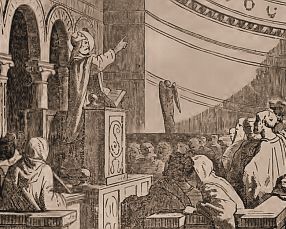 Barbatus returned to Benevento, where he was received with joy. When St. Barbatus entered upon his ministry in that city, the Christians themselves retained many idolatrous superstitions, which even their duke, Prince Romuald, authorized by his example, though son of Grimoald, King of the Lombards, who had edified all Italy by his conversion. They expressed a religious veneration for a golden viper, and prostrated themselves before it; they also paid superstitious honor to a tree, on which they hung the skin of a wild beast; and those ceremonies were closed by public games, in which the skin served for a mark at which bowmen shot arrows over their shoulders. St. Barbatus preached zealously against these abuses, and at length he roused the attention of the people by foretelling the distress of their city, and the calamities which it was to suffer from the army of the Emperor Constans, who, landing soon after in Italy, laid siege to Benevento.
Ildebrand, Bishop of Benevento, dying during the siege, after the public tranquillity was restored St. Barbatus was consecrated bishop on the 10th of March, 663. Barbatus, being invested with the episcopal character, pursued and completed the good work which he had so happily begun, and destroyed every trace of superstition in the whole state. In the year 680 he assisted in a council held by Pope Agatho at Rome, and the year following in the Sixth General Council held at Constantinople against the Monothelites.
He did not long survive this great assembly, for he died on the 29th of February, 682, being about seventy years old, almost nineteen of which he had spent in the episcopal chair.
—-Excerpted from Butler's Lives of the Saints, Benziger Bros. ed. [1894]
Highlights and Things to Do:
- Read more about St. Barbatus:
Monday of the First Week of Lent
Station with San Pietro in Vincoli (St. Peter in Chains):
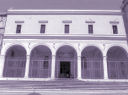
This church was one of the tituli, Rome's first parish churches, known as the Titulus Eudoxiae or the Eudoxiana. It was built over the ruins of an Imperial villa in 442 (or possibly 439), to house the chains that had bound St. Peter in prison in Jerusalem.
For more on San Pietro in Vincoli, see:
For further information on the Station Churches, see The Stational Church.