Ordinary Time: January 25th
Feast of the Conversion of St. Paul, Apostle
Free eBook:
|
| Free eBook: Liturgical Year 2023-2024, Vol. 4 |
MASS READINGS
January 25, 2013 (Readings on USCCB website)
COLLECT PRAYER
O God, who taught the whole world through the preaching of the blessed Apostle Paul, draw us, we pray, nearer to you through the example of him whose conversion we celebrate today, and so make us witnesses to your truth in the world. Through our Lord Jesus Christ, your Son, who lives and reigns with you in the unity of the Holy Spirit, God, for ever and ever.
Recipes (8)
Activities (8)
Prayers (7)
Library (8)
Blog & Podcasts (1)
» Enjoy our Liturgical Seasons series of e-books!
St. Paul, named Saul at his circumcision, a Jew of the tribe of Benjamin, was born at Tarsus, the capitol of Cilicia. He was a Roman citizen. He was brought up as a strict Jew, and later became a violent persecutor of the Christians. While on his way to Damascus to make new arrests of Christians, he was suddenly converted by a miraculous apparition of Our Lord. From a fierce persecutor he became the great Apostle of the Gentiles. He made three missionary journeys which brought him to the great centers of Asia Minor and southern Europe, and made many converts. Fourteen of his Epistles are found in the New Testament. He was beheaded in Rome in 66, and his body is kept in the Basilica of St. Paul near the Ostian Way.
The Week of Prayer for Christian Unity
St. Paul
St. Paul was born at Tarsus, Cilicia, of Jewish parents who were descended from the tribe of Benjamin. He was a Roman citizen from birth. As he was "a young man" at the stoning of Stephen and "an old man" when writing to Philemon, about the year 63, he was probably born around the beginning of the Christian era.
 To complete his schooling, St. Paul was sent to Jerusalem, where he sat at the feet of the learned Gamaliel and was educated in the strict observance of the ancestral Law. Here he also acquired a good knowledge of exegesis and was trained in the practice of disputation. As a convinced and zealous Pharisee, he returned to Tarsus before the public life of Christ opened in Palestine.
Some time after the death of Our Lord, St. Paul returned to Palestine. His profound conviction made his zeal develop to a religious fanaticism against the infant Church. He took part in the stoning of the first martyr, St. Stephen, and in the fierce persecution of the Christians that followed.
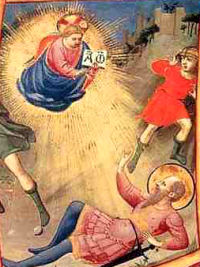
Entrusted with a formal mission from the high priest, he departed for Damascus to arrest the Christians there and bring them bound to Jerusalem. As he was nearing Damascus, about noon, a light from heaven suddenly blazed round him. Jesus with His glorified body appeared to him and addressed him, turning him away from his apparently successful career.
An immediate transformation was wrought in the soul of St. Paul. He was suddenly converted to the Christian Faith. He was baptized, changed his name from Saul to Paul, and began travelling and preaching the Faith. He was martyred as an Apostle in Rome around 65 AD.
—Excerpted from Lives of the Saints
Originally today's feast did not commemorate the apostle's conversion but rather the translation of his relics; and it was chronologically associated with the feast of St. Peter's Chair at Rome, formerly celebrated on January 18. Gradually, however, the original purpose was forgotten, and what had been a feast honoring the apostle's relics became the commemoration of his conversion.
With festal liturgy the Church commemorates Paul's conversion because of its supreme importance to Christianity. The conversion took place about five years after our Lord's death (the older Martyrology says two years). It was a sudden occurrence, not of the apostle's seeking but due wholly to divine intervention. St. Paul refers to it frequently in his epistles, always with the profoundest emotion and gratitude. The Acts of the Apostles gives a detailed account of the event, not once but three times: 9:1-22; 22:3-21; 26:9-18.
Paul's conversion, to repeat, was a most decisive moment in the development of God's kingdom on earth. Thanks to his uncompromising spirit the Church shook off the bonds of Judaism and spread to the Gentiles. Paul it was who brought the faith of Christ to Europe and, yes, to Rome. Through him the Church became what it is by nature—universal, catholic. Accordingly, we, too are indebted to him. With sentiments of deepest gratitude we celebrate that memorable event when grace scored so clean a victory over nature and human will. Indeed, we could call today's mystery a feast in honor of "Grace Triumphant."
Still, the apostle's will was not slighted; rather, grace was wedded to will. As he himself said later: "God's grace in me has not been fruitless" (1 For 15:10).
St. Paul's soul-shaking experience on the road to Damascus is not without a parallel in our life. Our first conversion was in baptism, when Christ came to dwell in us. It was a day of pure grace, without the least merit on our part. We were, it is true, unaware of the gift received—which from some viewpoints is regrettable. In the primitive Church adult baptism was common and the impression made was most profound. For the recipients it means a real conversio, a complete reversal of their manner of life. Think, for example, of St. Augustine.
Most of us, on the other hand, were baptized as infants. Now we find that in addition to our first conversion, we must undergo another. If we are lukewarm of sinful Christians, or if, as so often happens, we are Christians merely from habit or routine—unconscious Christians, as it were—then we must be reconverted to a life that is earnestly, consciously, zealously Christian. How important then to make the meaning of baptism constantly effective! Today's feast should be dedication to this purpose. Our celebration should include gratitude to God for that first conversion we do not remember and for the return to Him we do remember.
I know of another "Damascus hour" in my life, holy Mass. Here, too, Christ meets me. Here, grace is added to the grace of my first conversion to perfect what was there begun and to maintain in me the same unfailing consciousness of conversion that we admire in St. Paul. Twenty, thirty years later he was still moved to tears whenever his thoughts turned to that unforgettable moment on the way to Damascus. He, indeed, is a great man in whom the memory of a momentous experience never fades. For the mere act of conversion is not enough. Conversion must be lasting, and our "Damascus hour" at Mass helps make it so. Every Mass affects a conversio, a change in me. I bring my human wants and weaknesses to the altar, and in exchange receive divine life and strength. I bring human bread (at the Offertory) and receive divine Bread (in holy Communion). I go to Mass a Saul, I come from Mass a Paul.
—The Church's Year of Grace by Pius Parsch
Patronage: against hailstorms; against poisonous snakes; against snake bites; against snakes; Catholic Action; Cursillo movement; gentiles; lay people; Worshipful Company of Fruiterers; Worshipful Company of Upholders; authors; evangelists; hospital public relations; journalists; knights; missionary bishops; musicians; newspaper; editorial staff; public relations personnel; public relations work; publishers; reporters; rope braiders; rope makers; saddle makers; saddlers; tent makers; writers
Symbols and Representation: Book and sword; three fountains; two swords; scourge; serpent and a fire; armour of God; twelve scrolls with names of his Epistles; phoenix; palm tree; shield of faith; sword; book.
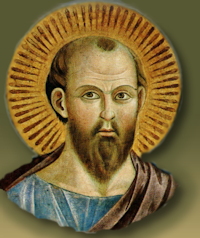
Often portrayed as: Thin-faced elderly man with a high forehead, receding hairline and long pointed beard; man holding a sword and a book; man with 3 springs of water nearby.
Highlights and Things to Do:
- Visit this section on Catholic Culture prepared for the Year of St. Paul in 2008.
- Read more on the Conversion of St. Paul:
- Many artists depicted the conversion of St. Paul. One of the most popular paintings is by Caravaggio. There is also the fresco by Michelangelo that is very inspiring.
- The tomb of St. Paul is located in Basilica of St. Paul Outside the Walls in Rome.
- See some food ideas on Catholic Cuisine.
- One of the traditions attached to this feast is found in rural England. Similar to the United States Groundhog Day tradition, weather predictions included fine days predicting good harvests, to clouds and mists foretelling pestilence and war in the coming months.