Ordinary Time: August 11th
Memorial of St. Clare, virgin
Other Commemorations: Sts Tiburtius and Susanna, Martyrs (RM)
Free eBook:

|
| Free eBook: Practical Theology |
MASS READINGS
August 11, 2012 (Readings on USCCB website)
COLLECT PRAYER
O God, who in your mercy led Saint Clare to a love of poverty, grant, through her intercession, that, following Christ in poverty of spirit, we may merit to contemplate you one day in the heavenly Kingdom. Through our Lord Jesus Christ, your Son, who lives and reigns with you in the unity of the Holy Spirit, God, for ever and ever.
Recipes (1)
Activities (3)
Prayers (2)
Library (10)
Blog & Podcasts (4)
» Enjoy our Liturgical Seasons series of e-books!
St. Clare of Assisi was the first woman to practice the life of entire poverty as taught by St. Francis. Placed by him at the head of a few companions in the small convent of San Damiano, she governed her community for forty-two years thus founding at the gates of Assisi the Order of Poor Clares. Their Rule included austerities hitherto unknown in monasteries of women. They went barefoot, slept on the ground, kept perpetual abstinence and made poverty the basis of their lives. St. Clare died on August 11, 1253, and was canonized two years after her death.
According to the 1962 Missal of Bl. John XXIII the Extraordinary Form of the Roman Rite, today is the feast of Sts. Tiburtius and Susanna. St. Tiburtius is a Roman martyr of unknown date who is buried on the Via Laviacana in the cemetery known nowadays as the catacomb of Sts. Peter and Marcellinus. St. Susanna, a Roman virgin, was also martyred at an unknown date. There are two churches in Rome which bear her name.
Historically today is the feast of St. Philomena, a young virgin and martyr of the fourth century.
St. Clare
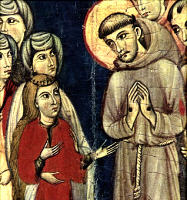 The Breviary says of her: "Following the example of St. Francis, she distributed all her possessions among the poor. She fled from the noise of the world and betook herself to a country chapel, where St. Francis himself sheared off her hair and clothed her with a penitential garb (on March 18, 1212, at the age of eighteen). Then she resided at the Church of St. Damian, where the Lord provided for her a goodly number of companions. So she established a community of nuns and acted as their superior at the wish of St Francis. For forty-two years she directed the nunnery with zeal and prudence, her own life serving as a constant sermon for her sisters to emulate. Of Pope Innocent IV she requested the privilege that she and her community live in absolute poverty. She was a most perfect follower of St. Francis of Assisi.
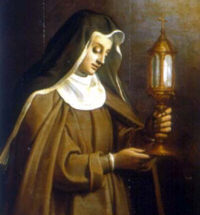
"When the Saracens were besieging Assisi and were preparing to attack the convent, St. Clare asked to be assisted as far as the entrance, for she was ill. In her hand she carried a vessel containing the blessed Eucharist as she prayed: O Lord, do not deliver over to beasts the souls that praise You! (Ps. 73). Protect Your servants, for You have redeemed them by Your precious Blood. And in the midst of that prayer a voice was heard, saying: Always will I protect you! The Saracens took to flight."
Heroic in suffering (she was sick for twenty-seven years), she was canonized only two years after her death. Thomas of Celano coined the saying: Clara nomine, vita clarior, clarissima moribus.
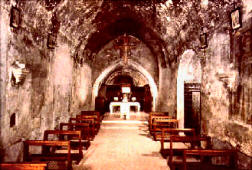 Clare was the first flower in the garden of the Poor Man of Assisi. Poor in earthly goods, but rich in her utter poverty, she was a replica of Jesus, poor in the crib and on the Cross. At her time the Church generally and many Church men were enmeshed in financial matters and political maneuvering. Through the renewal of the ideal of poverty, St. Francis effected a "reform of Christian life in head and members."
In our twentieth century there still remain large areas with millions suffering under extreme poverty. Poverty in itself is no virtue; but it should be made into a virtue. Let us recall a few of the examples and texts from holy Scripture which show how precious poverty is and what deep reverence we should have toward it. Christ was poor. His entrance into the world and His departure from it took place in circumstances of greatest need. He had no house wherein to be born, no crib; no house wherein to die, no deathbed. Poverty stood watch at birth and remained to see His death. "The foxes have dens and the birds of the air have nests; but the Son of Man has nowhere to lay His head" (Matt. 3:20).
At least we can be moderate and frugal, and thereby find the way to the spirit of Christian poverty. St. Clare, help us.
—Excerpted from The Church's Year of Grace, Pius Parsch
Patronage: Embroiderers; eye disease; eyes; gilders; goldsmiths; gold workers; good weather; laundry workers; needle workers; Santa Clara Indian Pueblo; telegraphs; telephones; television; television writers.
Symbols and Representation: Chalice and host; tall cross; Monstrance; lily; ciborium.
Often Portrayed as: Woman with a monstrance in her hand; Nun holding a vessel containing the holy Eucharist.
Highlights and Things to Do:
- Learn more about St. Clare:
- St. Clare's relics rest in The Basilica of Santa Chiara in Assisi, Italy. More information in English available here and here.
- This Franciscan Archive page dedicated to St. Clare has links to her writings, biographies, religious congregations, papal documents, and more.
- See images and information about the Founder Statue of St. Clare on St. Peter's Colonnade.
- Visit Catholic Cuisine for some food feast inspiration.
- Read Pope Benedict XVI's General Audience on St. Clare
- Although not comprehensive, this site maintains the list of different Poor Clare Orders around the world.
- One of the divisions of the cloistered and contemplative Poor Clares is the "Poor Clare Federation of Mary Immaculate," which has 12 monasteries in the United States. One of the more known monasteries is the one in Roswell, New Mexico, where Mother Mary Francis, P.C.C. (1921-2006) was Mother Superior. Some of her books have been published by Ignatius Press. All her writings are highly recommended. She wrote a book on St. Clare, which is self-published and available through the sisters in NM.
- Read a short biography of St. Clare by Mother M. Angela, P.C.C..
- Mother Angelica of EWTN was a Poor Clare. Her monastery is Poor Clares of Perpetual Adoration at Our Lady of the Angels Monastery in Hanceville, Alabama.
Sts. Tiburtius and Susanna
 A sense of reverential awe and deep respect fills us whenever we meet the martyrs of the ancient Church. Yet it is often very difficult to give a strictly historical account of their lives. Nevertheless, even though we do not know all the biographical details, they are for us representatives of that "army of light," the martyrs, witnesses to Christ. And we want to be inspired by their example. Today the older Martyrology tells this: "At Rome, between the two laurel trees, the death of the holy martyr Tiburtius. During the persecution of Diocletian the magistrate Fabian forced him to tread barefoot upon burning coals. As it only served to make him profess the faith more boldly, he was ordered to be led outside the city until the third milestone and there beheaded. . . . At Rome, the holy virgin Susanna. She came from an illustrious family, and was the niece of the saintly Pope Cams. At the time of Diocletian she won the palm of martyrdom by being beheaded."
—Excerpted from The Church's Year of Grace, Pius Parsch
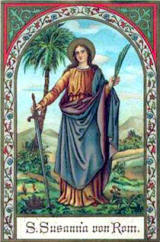
St. Susanna of Rome was a Roman noble, the beautiful daughter of Saint Gabinus, and niece of Pope Caius, living in the early part of Diocletian‘s reign when the last large-scale persecutions were building steam. Having made a private vow of virginity, and not wanting to be part of a family that murdered her family in faith, she refused to marry Maximian, Diocletian‘s son-in-law. Her piety was such that she converted Claudius and Maximus, relatives and the messengers sent to bring her to Maximian. In revenge, she was exposed as a Christian, beaten, and martyred.
No reliable Acta of her life have survived, but her story has, and she is commemorated in many ancient Martyrologies. A Roman parish and church has borne her name since the fifth century. In 1969 she was dropped from the General Roman Calendar of saints, but she is still included in the current Roman Martyrology and her memorial is still celebrated in Saint Susanna’s basilica in Rome.
—From Catholic Saints Info
Symbols and Representation: Susanna Crown at her feet; sword.
Highlights and Things To Do:
- Learn more about St. Susanna from the Catholic Encyclopedia. Her feast was removed from the General Roman Calendar in 1969.
- See St. Susanna's Statue in the Colonnade in St. Peter's.
- The Church of Santa Susanna in Rome is considered the American Church in Rome but has been closed to the public since 2013 due to falling items from the ceiling. St. Patrick's is now the American Church in Rome. Visit Roman Churches and Wikipediafor more information about the Church of Santa Susanna.
- In the Basilica of the Shrine of the Immaculate Conception in DC, the lower crypt church contains beautiful mosaics dedicated to women saints, including St. Susanna of Rome. See this page under the "East Apse" for more information, and this site for a close up of the beautiful mosaic.
- Much less information is known about Tiburtius. CatholicSaints.info for basic information. It is uncertain why these two saints are partnered together, since they died almost ten years apart.