Ordinary Time: November 2nd
The Commemoration of all the Faithful Departed (All Souls)
Other Titles: All Souls Day

MASS READINGS
November 02, 2011 (Readings on USCCB website)
COLLECT PRAYER
Merciful Father, hear our prayers and console us. As we renew our faith in your Son, whom you raised from the dead, strengthen our hope that all our departed brothers and sisters will share in his resurrection, who lives and reigns with you and the Holy Spirit, God, for ever and ever. Amen.
Recipes (22)
Activities (12)
Prayers (9)
Library (12)
Blog & Podcasts (14)
» Enjoy our Liturgical Seasons series of e-books!
"On this day is observed the commemoration of the faithful departed, in which our common and pious Mother the Church, immediately after having endeavored to celebrate by worthy praise all her children who already rejoice in heaven, strives to aid by her powerful intercession with Christ, her Lord and Spouse, all those who still groan in purgatory, so that they may join as soon as possible the inhabitants of the heavenly city." — Roman Martyrology
Every priest is permitted to say three Masses on this day and it would be a good practice for the laity to attend three Masses and offer them for the Poor Souls.
All Souls Indulgences
An indulgence, applicable only to the souls in purgatory, is granted to the faithful, who devoutly visit a cemetery and pray, even if only mentally, for the departed. The indulgence is plenary each day from the first to the eighth of November; on other days of the year it is partial.
A plenary indulgence, applicable only to the souls in purgatory, is granted to the faithful, who on the day dedicated to the Commemoration of All the Faithful Departed [November 2 {as well as on the Sunday preceding or following, and on All Saints' Day}] piously visit a church. In visiting the church it is required that one Our Father and the Creed be recited.
To acquire a plenary indulgence it is necessary also to fulfill the following three conditions: sacramental Confession, Eucharistic communion, and prayer for the intention of the Holy Father. The three conditions may be fulfilled several days before or after the performance of the visit; it is, however, fitting that communion be received and the prayer for the intention of the Holy Father be said on the same day as the visit.
The condition of praying for the intention of the Holy Father is fully satisfied by reciting one Our Father and one Hail Mary. A plenary indulgence can be acquired only once in the course of the day.
All Souls Day
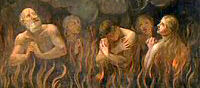 The Church, after rejoicing yesterday with those of her children who have entered the glory of heaven, today prays for all those who, in the purifying suffering of Purgatory await the day when they will be joined to the company of saints. At no place in the liturgy is stated in more striking fashion the mysterious union between the Church triumphant, the Church militant and the Church suffering; at no time is there accomplished in clearer fashion the twofold duty of charity and justice deriving for every Christian from the fact of his incorporation in the mystical Body of Christ. By virtue of the consoling doctrine of the communion of saints the merits and prayers of each one are able to help all; and the Church is able to join her prayer with that of the saints in heaven and supply what is wanting to the souls in Purgatory by means of the Mass, indulgences and the alms and sacrifices of her children.
The celebration of Mass, the sacrifice of Calvary continued on our altars, has ever been for the Church the principal means of fulfilling towards the dead the great commandment of charity. Masses for the dead are found in the fifth century. But it was St. Odilo, fourth abbot of Cluny, who was responsible for the institution of the general commemoration of all the faithful departed; he instituted it and fixed its celebration on November 2, the day after All Saints. The practice spread to the rest of Christendom.
Daily in a special Memento in the Canon of the Mass, at which the priest remembers all those who have fallen asleep in the Lord, the priest implores God to grant them a place of happiness, light and peace. Thus there is no Mass in which the Church does not pray for the faithful departed; but today her thoughts are directed towards them in a particular fashion, with the maternal preoccupation of leaving no soul in Purgatory without spiritual aid and of grouping them all together in her intercession. By a privilege that Benedict XV's decree has extended to the whole world every priest can today celebrate three Masses; for the liberation of the souls in Purgatory the Church multiplies the offering of the sacrifice of Christ, from which she draws forever on behalf of all her children, infinite fruits of redemption.
Highlights and Things to Do:
- Add some pious practices to help the souls in Purgatory: attend three Masses for the faithful departed on this day; remember your family and friends who are deceased and make an extra sacrifice for them; pray the rosary for the most forgotten soul in Purgatory.
- An indulgence, applicable only to the Souls in Purgatory, is granted to the faithful, who devoutly visit a cemetery and pray, even if only mentally, for the departed. The indulgence is plenary each day from November 1-8; on other days of the year it is only a partial indulgence. The plenary indulgence is earned under the usual conditions: sacramental confession (within 20 days before or after), one Eucharistic Communion for each visit (20 days before or after), and prayer for the Pope's intentions (usually one Our Father and the Creed or Hail Mary, prayed each visit) while detached from sin. See Praying for the Dead and Gaining Indulgences During November for more information about indulgences for the souls in Purgatory.
- There is also solemn commemoration from the Book of Blessings that can be used on All Souls. See Visiting a Cemetery on All Souls Day, Memorial Day, or on the Anniversary of Death or Burial.
- Read more about the Commemoration of All Souls:
- Make a poster listing all your departed family and friends. Put this on display where the members of the family can be reminded to pray for the loved ones throughout November. Remind family members to offer extra prayers and sacrifices for the souls in Purgatory. Of course this shouldn't be the only motivation, but do include the fact that after these souls reach heaven, they will intercede on your behalf.
- Read the Directory on Popular Piety and the Liturgy and the section entitled "The Memorial of the Dead in Popular Piety." Of particular note:
The Christian, who must be conscious of and familiar with the idea of death, cannot interiorly accept the phenomenon of the "intolerance of the dead," which deprives the dead of all acceptance in the city of the living. Neither can he refuse to acknowledge the signs of death, especially when intolerance and rejection encourage a flight from reality, or a materialist cosmology, devoid of hope and alien to belief in the death and resurrection of Christ.
- Have family discussions about death, preparing for death, funerals, and the Sacrament of the Sick. Visit the cemetery with children. Visits to the cemetery can be uplifting, calm and peaceful and not a scary event.
- From the Catholic Culture library:
- Purgatory And Catechesis,
- Holy Souls in Purgatory,
- Mystery of God's Justice and Mercy
- The Doctrine of Purgatory
For many more documents search the library for "Purgatory."
- In many places this day centers around the family departed and the cemetery. Families go to gravesites, clean them, decorate them, add candles. This can be an all-day affair, with picnics and celebration. Of particular note is the Dia de los Muertos or the Day of the Dead, celebration in Mexico on November 2. One could say this is the "Mexican Halloween." For more information on this Catholic holiday, see Mexico Connect for a variety of links for information. Please note that as with many holidays, there is much commercialism and secularism. Read Directory on Popular Piety and the Liturgy to understand the harmony that piety and devotions must have with the Liturgy.
Deeply rooted cultural elements connoting particular anthropological concepts are to be found among the customs and usages connected with the "cult of the dead" among some peoples. These often spring from a desire to prolong family and social links with the departed. Great caution must be used in examining and evaluating these customs. Care should be taken to ensure that they are not contrary to the Gospel. Likewise, care should be taken to ensure that they cannot be interpreted as pagan residues.
- To make sugar skulls for the Day of the Dead, see Mexican Sugar Skull or How to Make Sugar Skulls.
- See the drop down recipe section at the top for the many recipes connected to this day. Of particular note is the English "Soul Cakes," the Italian "Eggs in Purgatory" and Fave dei Morti (Beans of the Dead), "Bread of the Dead" from Mexico, and "Dry Bones Cookies" from Switzerland. See also Catholic Cuisine for other recipe ideas.
Visiting a Cemetery: An indulgence, applicable only to the Souls in Purgatory, is granted to the faithful, who devoutly visit a cemetery and pray, even if only mentally, for the departed. The indulgence is plenary each day from November 1-8; on other days of the year it is a partial indulgence.
Visiting a Church on November 2: A plenary indulgence, applicable only to the souls in purgatory, is granted to the faithful who, on All Souls' Day (or, according to the judgment of the ordinary, on the Sunday preceding or following it, or on the solemnity of All Saints), devoutly visit a church or an oratory and recite an Our Father and the Creed.
Praying for the Faithful Departed: A partial indulgence, applicable only to the souls in purgatory, is granted to the faithful who,
- devoutly visit a cemetery and at least mentally pray for the dead;
- devoutly recite lauds or vespers from the Office of the Dead or the prayer Eternal rest. (Manual of Indulgences, fourth edition, 1999)
Indulgence Requirements:
- To gain a plenary indulgence, in addition to excluding all attachment to sin, even venial sin, it is necessary to perform the indulgent work and fulfill the following three conditions: sacramental Confession, Eucharistic Communion, and prayer for the intention of the Sovereign Pontiff.
- A single sacramental confession suffices for gaining several plenary indulgences, but Holy Communion must be received and prayer for the intention of the Holy Father must be recited for the gaining of each plenary indulgence.
- The three conditions may be fulfilled several days before or after the performance of the prescribed work; it is, however, fitting that Communion be received and the prayer for the intention of the Holy Father be said on the same day the work is performed.
- The condition of praying for the intention of the Holy Father is fully satisfied by reciting one Our Father and one Hail Mary. A plenary indulgence can be acquired only once in the course of the day, a partial indulgence can be acquired multiple times.
- If a visit to a Church or an oratory is required to obtain an indulgence attached to a particular day, this may be accomplished from noon of the preceding day until midnight of the particular day.
Manual of Indulgences, fourth edition, 1999 (Enchridion Indulgentarium)